
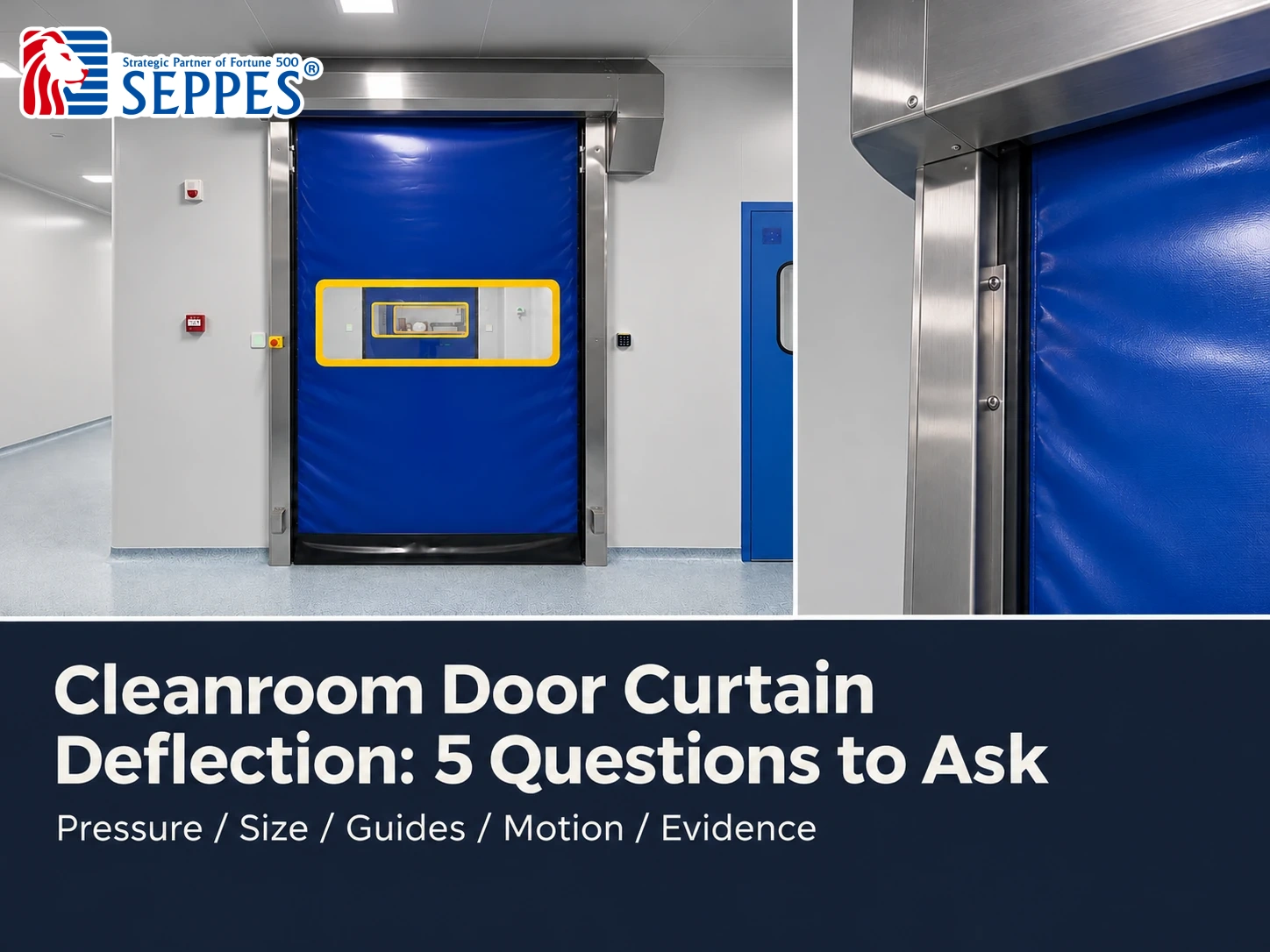

Cleanroom door curtain deflection can raise an immediate purchasing question: does the opening need a different door, a different curtain or a change elsewhere in the room? A photograph of a curved PVC surface cannot settle that question. The useful starting point is to connect the observed shape with the pressure difference, opening dimensions and door state at the same moment.
A flexible curtain can change shape under load without telling you, by appearance alone, whether its guides remain properly engaged, whether the drive can move it as intended or how much air passes through the assembly. These are separate performance questions. Treating all of them as a single claim about a stronger curtain can leave the actual problem unresolved.
For a SEPPES cleanroom project, the specification should describe the complete door arrangement and the conditions it must accommodate. The following five questions turn a discussion about visible bowing into a more useful review of load, structure, movement and supporting evidence.
1. What Pressure Difference Was Present When the Curtain Bowed?
Start with the pressure difference across the particular opening, including which side is at higher pressure. A room display may compare that room with a reference location that is not the space immediately beyond the door. Confirm the measurement reference before treating the displayed value as the load acting across the curtain.
Record whether the shape appears during steady closed operation, when a neighbouring door changes state or during a ventilation transition. A reading taken well after the event may miss the condition that produced it. Time-aligned observations are more useful than an isolated maximum value with no indication of what the doors and ventilation system were doing.
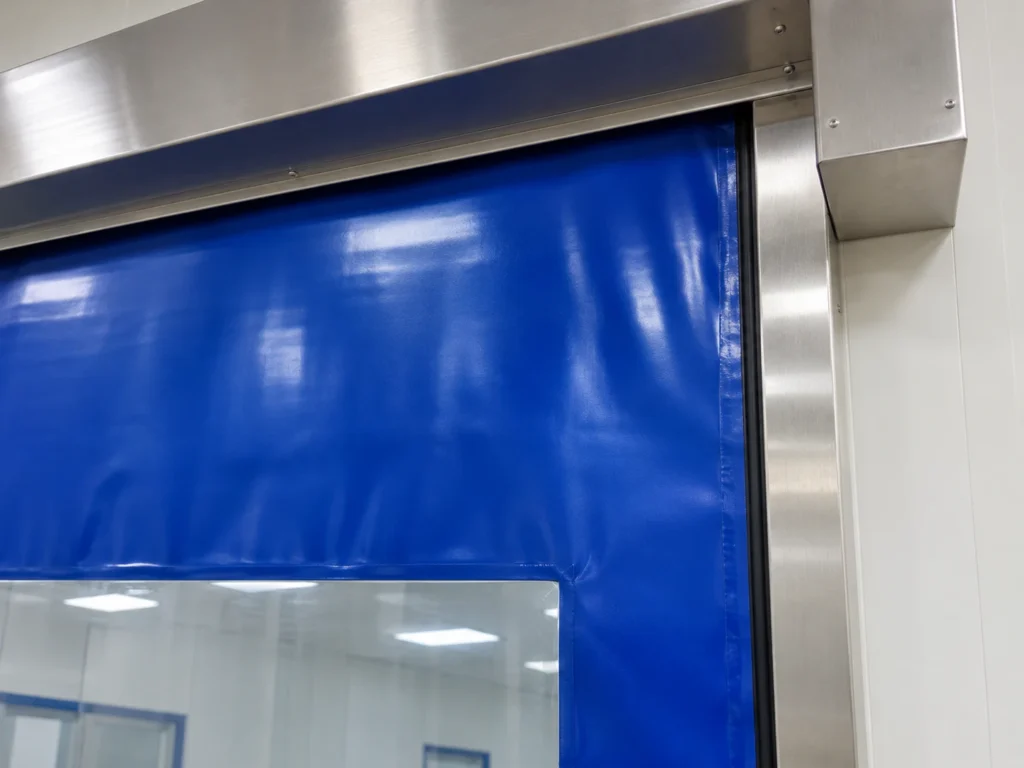
When documenting cleanroom door panel bowing, distinguish a broad curve across the surface from local wrinkles, an uneven bottom edge or distortion concentrated beside one guide. Note the direction and repeatability of the change. The pattern can help organise an investigation, but it does not prove that pressure is the only cause; alignment, material condition and previous impact may also need review.
For a meaningful comparison, record where displacement is observed and what it is measured against. Movement at the centre of the curtain is different from movement of the guide or its supporting frame. A photograph taken from a different angle can also make the same shape appear more or less pronounced. Agree a consistent observation position and a suitable measurement method with the supplier, keeping people clear of the moving assembly. Repeat the observation under comparable conditions so that a change in the record reflects the door’s behaviour rather than a change in how it was observed.
This establishes a baseline for cleanroom door curtain deflection: a named opening, a defined operating condition and an observation tied to that condition. Keep the facility’s required pressure regime in view. Reducing a pressure setting simply to make the curtain look flatter could conflict with the room’s intended environmental control.
2. How Much Load Does the Actual Opening Carry?
Cleanroom door pressure loading depends on both the pressure difference and the exposed area. Pressure is force per unit area, as explained in NASA’s introduction to air pressure. For an approximately uniform pressure difference across a closed rectangular curtain, the resultant normal force can be estimated as F = Δp × A.
Consider an illustrative calculation, not a SEPPES rating or recommended room setting. A 2.5 m × 3.0 m opening has an area of 7.5 m². At an assumed uniform pressure difference of 20 Pa, the estimated force is 150 N. A 3.0 m × 4.0 m opening under the same assumption carries 240 N, an increase of 60 percent.
That arithmetic does not predict how far either curtain will deflect. The response also depends on span, material properties, reinforcement, edge support and the assembly’s geometry. Nor should the total force simply be divided equally between the guides to select fixings. The actual load path through the curtain, guides, head assembly and supporting structure needs a configuration-specific assessment.
Use the calculation to challenge an incomplete comparison: was the supporting test performed on a door with a relevant size and construction? Cleanroom door pressure loading is a reason to request the tested dimensions and the permitted range of application. A result for one opening should not be extended to a larger or differently proportioned opening without the supplier’s supporting justification.
3. What Holds the Curtain Edges in the Guides?
Cleanroom door guide retention concerns how the curtain edges remain engaged as the assembly is loaded and operated. Review the actual edge profile, guide geometry, supports and approved reinforcement arrangement. Curtain thickness on its own does not describe that system. A material upgrade can change one component while leaving the limiting interface elsewhere.
The SEPPES high speed roll up door uses double-row brush guides in its reference configuration, while the SEPPES zipper high speed door has a different curtain-edge arrangement. These are useful starting points for a configuration comparison. The product name or guide type alone does not establish the pressure range or leakage performance of the proposed installation.
When discussing cleanroom door curtain tension, first establish whether the selected design has a manufacturer-defined tensioning arrangement and what its purpose is. Do not assume every flexible door provides the same adjustment. Changing tension can alter the interaction between the curtain, guides and drive, so a visually flatter surface is not a sufficient reason to make an unapproved adjustment.
Ask how cleanroom door guide retention was assessed for the quoted combination of curtain, guides and opening size. Include the interface between the guide and its supporting wall or frame. An edge that remains engaged in a test rig does not, by itself, establish that a different site mounting arrangement will behave identically.
4. Does the Door Behave Differently While Moving?
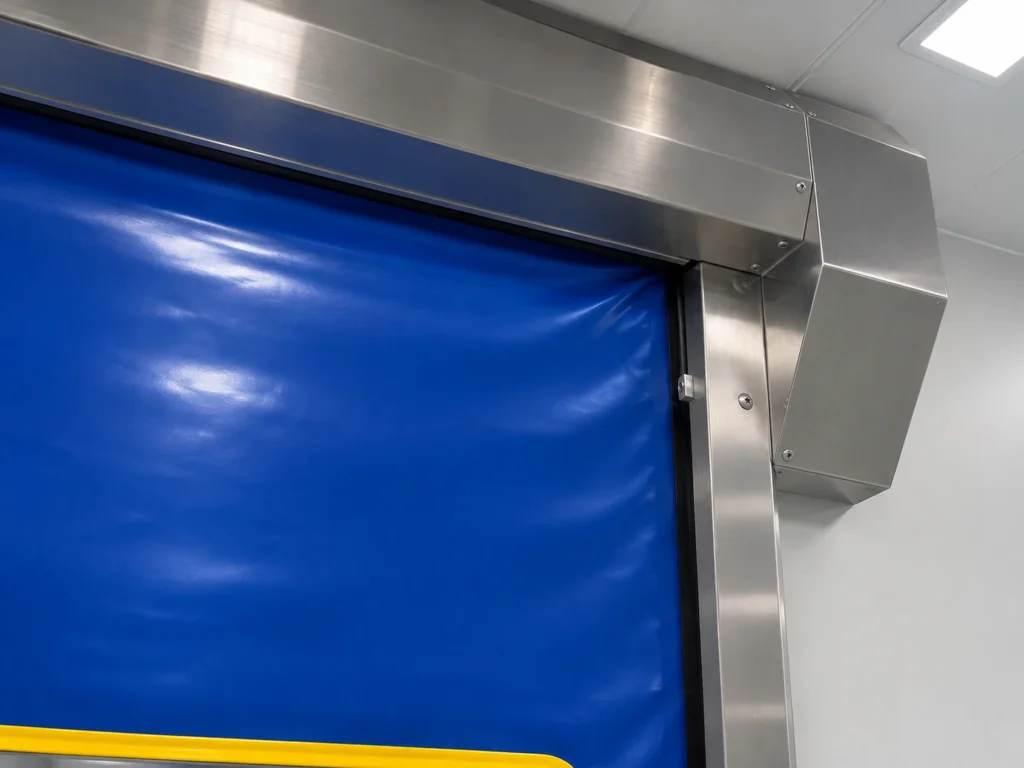
Assess cleanroom door curtain deflection in both the closed and travelling states. As the opening changes, the airflow path, pressure difference and length of curtain engaged in the guides can change too. A door that remains in place under a static condition therefore needs separate evidence for the opening and closing duties required by the project.
The distinction matters when a quotation relies on a wind-load classification. The published scope of EN 12424 addresses doors in the closed position. It should not be read as automatic permission to operate a cleanroom door at the same pressure or as proof of a particular air-leakage result.
Specify the relevant duty: the pressure conditions before opening, the required travel sequence and the condition to be restored after closure. During an agreed assessment, record repeatable rubbing, unusual movement, interruptions or loss of the expected final position. Relate observations to the room state rather than assuming that every interruption comes from the curtain material.
Changes to cleanroom door curtain tension, travel settings or protective functions should remain within the manufacturer’s procedures and competent technical review. HSE’s powered-door guidance emphasises the combined system and its circumstances of use. Increasing drive force or bypassing protection to overcome resistance is not an acceptable substitute for resolving the cause.

5. Which Evidence Covers Cleanroom Door Curtain Deflection?
A useful report identifies the door model, opening dimensions, curtain build, guide arrangement, mounting conditions and applied pressure difference. It also states whether the door was stationary or cycling, where deformation was observed and what acceptance criteria were used. Without those details, a statement that the door passed a pressure test can mean several different things.
Keep the outcomes separate when comparing cleanroom door panel bowing reports. Maximum displacement during loading, shape after the load is removed, continued guide engagement, ability to cycle and measured leakage answer different questions. A report may support one of these outcomes without measuring the others. Ask for the evidence that matches the specific requirement in your project.
Agree the acceptance criteria before ordering. A requirement for limited visible movement, continued operation or a defined leakage result should identify its own conditions and assessment method. Room performance also has its own verification context: ISO 14644-3 covers cleanroom test methods and distinguishes as-built, at-rest and operational states. A curtain photograph cannot replace that room-level evidence.
A useful conclusion on cleanroom door curtain deflection identifies the particular assembly and the requirements it meets for a stated size, pressure condition and operating duty. Record any restrictions alongside that conclusion. This makes competing proposals easier to compare and gives the site team a meaningful basis for handover.
Build the SEPPES Enquiry Around the Operating Condition
Send SEPPES the clear opening size, the pressure difference across the actual doorway, the relevant room states and the required opening sequence. Include photographs or time-aligned observations of the curtain and guides, plus the environmental criteria the facility must retain. For a replacement project, identify the existing door configuration and any changes to ventilation, traffic or mounting conditions.
Use the SEPPES high speed roll up door product details as a starting point, then request confirmation for the proposed assembly. Resolving cleanroom door curtain deflection requires a match between the opening, the pressure conditions and the door system. A quote tied to those conditions is more useful than a thicker-curtain promise without an explained scope of performance.
