


Cleanroom door performance is most revealing during an ordinary material transfer. A covered trolley approaches, the curtain rises, an operator follows the load and the door closes again. The movement may take only a short time, yet the doorway has changed from a physical boundary into an open passage and back. The room must manage that transition every time.
SEPPES’s current brush-guided PVC roll-up door reference lists a 0.8 mm curtain and an operating speed of 0.6–1.8 m/s. These figures describe a starting configuration. They do not, by themselves, establish how an installed entrance will support a particular cleanroom.
The more useful way to understand cleanroom door performance is to follow what happens at the curtain edges, across its surfaces, through the open doorway and after closure. These four details explain why the door, its controls and the surrounding room need to be considered together.
On this page:
The Closed Curtain Depends on the Entire Perimeter
The Door Must Be Cleanable While Remaining a Moving Machine
An Open Door Temporarily Changes the Room Boundary
Cleanroom Door Performance Continues After Closure
What This Means for a SEPPES Cleanroom Door
1. The Closed Curtain Depends on the Entire Perimeter
When the curtain reaches the floor, cleanroom door performance depends on more than the broad sheet of PVC. The physical boundary also includes the side guides, bottom contact, overhead arrangement and frame-to-wall junction. Air can follow an unintended path at a connection even when the curtain itself appears flat and undamaged.
Cleanroom door perimeter integrity therefore concerns the complete installed outline. A smooth floor beneath the opening, consistent guide alignment and an appropriate wall connection all contribute to that outline. At the lower corners, the side and bottom arrangements meet; inspecting those transitions can reveal details that a front-facing product photograph does not show.
Pressure also acts mechanically on the curtain. In a simplified illustration, a uniform pressure difference of 20 Pa across a 6 m² curtain produces a resultant force of 120 N: pressure multiplied by area. This is not a SEPPES rating or a recommended room pressure. It shows why a modest pressure difference can still place a meaningful load on a large flexible surface.
That load is relevant to curtain shape and how its edges remain supported. SEPPES’s cleanroom-specific catalogue describes a separate zipper-guided configuration with curtain tensioning. It should not be confused with the brush-guided product linked above. The two edge arrangements must be evaluated as the assemblies actually supplied, rather than assuming one configuration’s features apply to the other.
A claim about cleanroom door performance becomes useful when the door size, pressure conditions and installation details are identified. Leakage evidence should describe the tested assembly and its conditions. Cleanroom door perimeter integrity cannot be inferred from a material name, a photograph or the fact that the curtain reaches its closed position.
Over time, the same perimeter needs to remain inspectable. A displaced edge, accumulated residue or a changed floor interface may deserve attention even if the drive still completes its cycle. This is where cleanroom door performance connects product construction with maintenance: the useful design allows the relevant contact areas to be examined and serviced.

2. The Door Must Be Cleanable While Remaining a Moving Machine
Cleanroom door performance also depends on what happens to the door’s own surfaces. Cleanroom door particle control includes managing material brought toward the opening, but it also requires attention to wear, retained debris and residues around moving components. An entrance is not made suitable for a cleanroom simply by giving its frame a polished appearance.
The curtain repeatedly bends around the roll, while its edges travel through the guide arrangement. Those contact zones deserve attention because their condition can change with use. The practical question is how the supplied design supports inspection, removal of retained material and replacement of parts that no longer meet the manufacturer’s condition criteria.
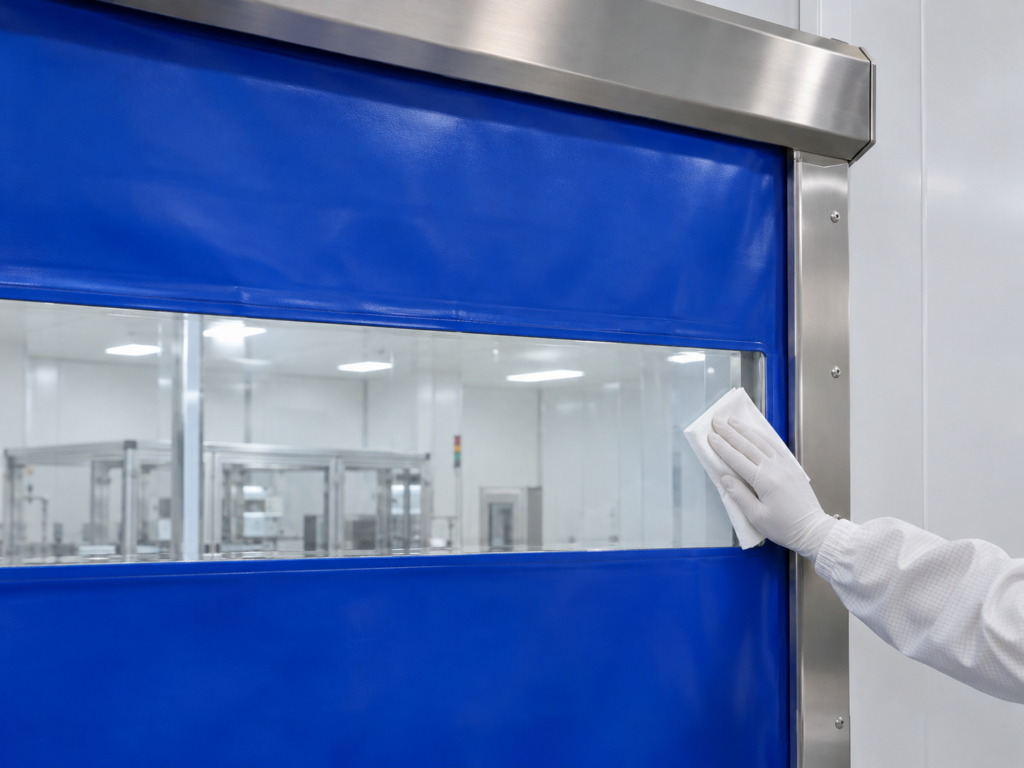
The vision panel is another small detail with wider consequences for cleanroom door performance. A projecting perimeter creates a different wiping route from a panel integrated flush with the curtain. SEPPES’s cleanroom-specific brochure describes the flush arrangement. Its relevance is the accessible transition between surfaces, not an automatic guarantee that every cleaning method is suitable.
Cleaning compatibility applies to the assembly, not just its largest material. The PVC curtain, clear panel, seals, coatings and any bonding materials may respond differently to repeated exposure. The facility’s agents, concentrations, contact times and wiping method therefore belong in the material review. Compatibility of a stainless steel frame does not establish compatibility of the adjoining window or curtain.
Cleanroom door particle control also has a service-access dimension. A guide can look neat from the corridor while being difficult to inspect once nearby equipment is installed. Removing a cover or replacing a worn part introduces a maintenance activity into the area. Providing access and a defined cleaning handover helps the facility manage that intervention.
For sterile medicinal-product facilities, EU GMP Annex 1, sections 4.5–4.7 address cleanable surfaces and material suitability.
3. An Open Door Temporarily Changes the Room Boundary
During transfer, cleanroom door performance shifts from maintaining a closed boundary to managing an interruption in that boundary. Cleanroom doorway airflow is affected by the opening, room ventilation, pressure relationships and movement through the passage. A closed-door leakage result describes a different condition from an entrance with a trolley halfway through it.
Speed matters because it influences curtain travel time. Yet the passage may also include a pause while an operator aligns a load, checks the destination or waits for space beyond the opening. A faster motor cannot remove a delay created by the route itself. The product and the transfer layout therefore influence each other.
Consider a covered trolley that clears the curtain but stops immediately inside the room. The operator may remain near the detection zone while repositioning it. The resulting open period can differ from the neat cycle seen in an empty-door demonstration. Evaluating cleanroom door performance with the actual load exposes this interaction without assuming the detection system is at fault.
A vision window contributes here through visibility. When its height and position suit the user and load, it can support a view of the opposite approach before a request is made. Its usefulness depends on the sightline: a large panel behind a tall container may offer less practical information than expected from its area alone.
Cleanroom doorway airflow also depends on what crosses the boundary. The door controls access, but it does not clean trolley wheels, remove packaging debris or replace the facility’s material preparation process. A covered load and a short opening period address different aspects of a transfer; neither makes the other unnecessary.
The useful contribution to cleanroom door performance is a repeatable passage: a clear approach, suitable activation, enough space to clear the opening and protection that remains effective for the people and load. A shorter exposure period should come from resolving unnecessary waiting, with closing behavior established through the approved operating and protection arrangements.
4. Cleanroom Door Performance Continues After Closure
The curtain reaching its closed position is a mechanical event. Environmental recovery is a room-level event. A cleanroom door recovery sequence needs to distinguish them, especially when a material airlock separates two areas. The next movement may depend on more than confirmation that the first door has stopped.
For cleanroom door performance, three conditions deserve separate definitions: the door is physically closed, the control system permits another action, and the room meets the process condition required for that action. These conditions may coincide in a simple application, but they should not be treated as identical without examining the intended process.
Pressure indication also needs careful interpretation. A pressure value returning to its target does not itself measure particle concentration or prove that every part of the room has recovered. The facility team determines which environmental conditions matter and how they are established. The door controller supports the agreed sequence rather than independently declaring the room clean.
SEPPES’s cleanroom-specific brochure describes interlock logic for coordinating multiple doors. Its practical value comes from connecting defined conditions to permitted movement. In a cleanroom door recovery sequence, that could include closed-position confirmation, a facility-defined delay or a confirmed external permission, according to the selected model and approved project design.
For sterile medicinal-product facilities, EU GMP Annex 1, section 4.13 addresses simultaneous airlock-door opening and grade-dependent interlock or warning arrangements.
These distinctions also make abnormal conditions easier to understand. If the first door closes but permission for the second remains unavailable, the operator needs a meaningful indication and an agreed response. Clearing a door fault and releasing a process condition are different actions. A well-defined handover explains both without encouraging staff to bypass the intended sequence.

What This Means for a SEPPES Cleanroom Door
Cleanroom door performance comes from the relationship between a physical product and a defined process. The flexible curtain provides the moving barrier; the guide and perimeter arrangement shape the closed boundary; accessible surfaces support cleaning; the drive and controls coordinate passage. None of those functions can be judged fully in isolation.
For a SEPPES project, the useful specification connects the chosen door configuration to the room’s actual demands. A frequent internal transfer route and a pressure-sensitive material airlock may require different evidence and arrangements, even when their curtains look similar. Keeping the brush-guided product and the separate cleanroom-specific zipper configuration clearly identified makes that discussion more precise.
Describe the boundary the door must maintain, the material movement that interrupts it and the condition required before the next transfer. That gives SEPPES a concrete basis for matching the curtain, guidance, surfaces and controls to the application. The result is a product proposal built around how the cleanroom operates throughout the day.
