
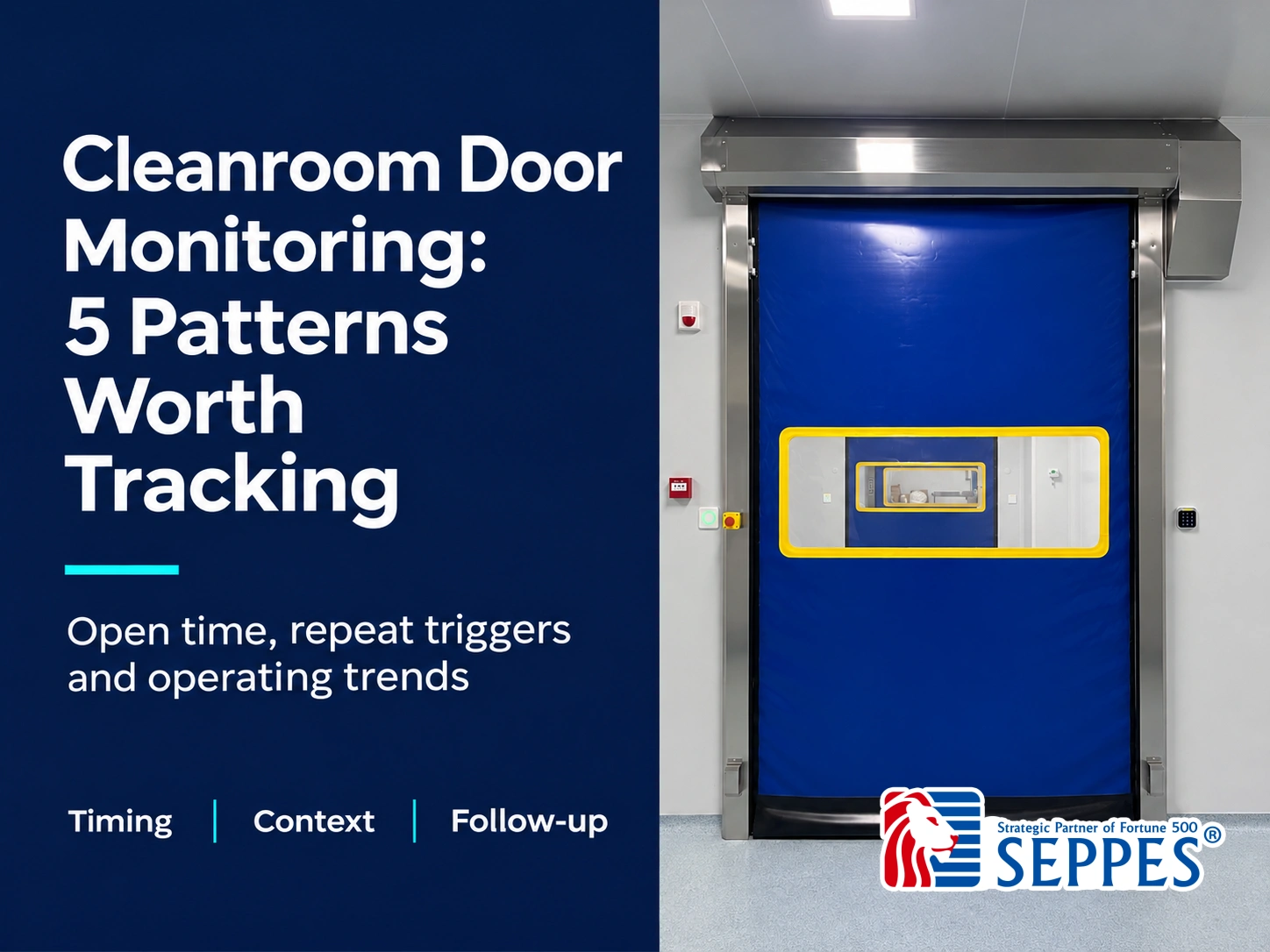

Cleanroom door monitoring becomes useful when it explains a change in daily operation. A door may still open and close normally while carts wait longer, the curtain reopens more often, or operators encounter repeated interruptions. Those changes deserve investigation, but they do not all point to a defective door.
For a SEPPES flexible high-speed door, the practical question is what changed between the accepted operating condition and the condition observed today. Useful evidence connects the door’s movement with the transfer task, the control sequence and the room’s operating state. A daily cycle total alone cannot explain that relationship.
The following five patterns offer a focused way to review operating records after commissioning. The numerical examples are illustrative calculations, not SEPPES test results, recommended settings or acceptance limits. Apply the method to your own opening and agreed operating requirements.
1. Gaps in the Cleanroom Door Monitoring Record
Before comparing days or shifts, establish what each recorded event means. An opening request is not proof that the curtain reached its open position. A closing command is not confirmation that the opening is closed. If a system records commands only, describe them as commands; do not silently convert them into measured door positions.
A useful cleanroom door event log identifies the opening, timestamp, event type, information source and operating mode. Where available, associate it with the transfer type and the reason for an interruption. These fields let a reviewer distinguish a maintenance observation from a production transfer and a manual note from a controller signal.
For product context, the SEPPES high speed roll up door uses a flexible PVC curtain and brush guides; its listed controls include a visual HMI and I/O and RS-485 connections. Confirm the supplied controller’s available signals and recording functions separately. An interface connection does not by itself establish a historical database or export function.
Manual observation can support an initial review when automatic records are unavailable. Keep the observation period and definitions consistent. In either format, flag missing timestamps, power interruptions and incomplete sequences. A blank period in the cleanroom door event log means the record is incomplete until explained; it does not demonstrate that nothing happened.
For cleanroom door monitoring, recording coverage is part of the evidence. A busy-hour observation cannot represent an entire shift without qualification. State when observation started and ended, which transfers it covered and where data were unavailable. This prevents a change in recording practice from looking like a change in the door.

2. Long Open Intervals Hidden by the Average
Define cleanroom door open time before reporting it. For this example, fully-open dwell runs from the curtain reaching its configured full-open position to the start of closing. It excludes opening and closing travel. If your concern is the entire interval during which the opening is not fully closed, record that broader interval separately, including interrupted closing movements.
Consider 100 completed, observed dwell intervals. Eighty last 8 seconds each; the remaining twenty last 30 seconds each. The calculation looks like this:
| Observed group | Number of intervals | Dwell per interval | Total dwell |
|---|---|---|---|
| Shorter intervals | 80 | 8 seconds | 640 seconds |
| Longer intervals | 20 | 30 seconds | 600 seconds |
| Combined | 100 | 12.4-second mean | 1,240 seconds |
The median is 8 seconds, yet only 20% of the intervals contribute about 48% of total dwell. A cleanroom door monitoring report that shows only the average hides where much of the open time accumulates. Review the longer intervals first: was a cart waiting, was a transfer incomplete, or was the opening deliberately held for an approved task?
This changes the improvement discussion. Shortening every closing delay may leave a staging problem unresolved. Comparing cleanroom door open time by transfer type can reveal which task needs attention. Neither the mean nor total dwell measures contamination entering the room; both describe door operation and require environmental evidence for conclusions about cleanliness.
Keep incomplete intervals visible as well. If observation ends while a door remains open, mark that interval as unfinished; excluding it without explanation can remove the longest event from the report. Reliable cleanroom door monitoring distinguishes a measured duration from a minimum observed duration and reports how many records fall into each group.

3. Repeat Triggers Around the Same Transfer
A door that starts closing and then reopens may be responding correctly to a new request or a protective input. The observed movement alone cannot distinguish normal passage, poor staging, an unsuitable activation arrangement or a fault. Useful cleanroom door monitoring preserves the sequence leading to the reopening, rather than grouping every reopening under one failure label.
Review a short sequence around the event: approach, request, opening, passage, clearance and closure. Record only the stages actually observed or confirmed by available signals. If repeated activations cluster around a cart’s waiting position, the approach layout becomes a reasonable investigation lead. If they also occur during observed empty-route periods, traffic alone becomes a less convincing explanation.
Where two doors serve an airlock or transfer sequence, identify the second door’s state as well. A waiting period caused by the agreed sequence differs from a door failing to respond. Do not infer the second door’s position from the first door’s controller unless that feedback is actually available and its meaning has been verified.
Keep protection functions intact while investigating. UK HSE guidance treats powered-door safety as a matter of the complete installation, its use and maintenance, not isolated components. Any proposed change to sensing or control behavior needs competent review against the installed system and its instructions. See HSE’s powered-door safety guidance.

4. Alarm Counts That Change with Traffic
Cleanroom door alarm analysis needs a consistent counting rule. One unresolved condition may generate several notifications or acknowledgements. Preserve those raw entries, but define how they are grouped into an incident for comparison. Keep different event classes separate: a protective activation, a drive fault and an operator stop do not describe the same condition.
Now consider two illustrative periods for the same event class. The first has 8 incidents across 400 comparable completed cycles: 2 incidents per 100 cycles. The second has 12 across 1,200 cycles: 1 per 100 cycles. The raw incident count increased, while the rate per cycle decreased. Neither number alone describes the full change.
Use the same event definition, cycle definition and recording coverage before making that comparison. Also retain duration and consequence: a single serious interruption can matter more than several brief notifications. Cleanroom door alarm analysis should separate frequency, severity and lost operating time, rather than combining them into a reassuring percentage.
The denominator should fit the question. Cycles can help compare movement-related events; observed operating hours may be more relevant to faults that occur while stationary. A useful cleanroom door monitoring report states both the rate and the underlying counts so the maintenance team can see what changed.
5. Door Patterns That Follow Changes in the Room
Cleanroom door operating trends become easier to interpret when reviewed beside relevant room records. Depending on the facility, these may include pressure trends, production schedules, transfer batches, cleaning periods or work on nearby equipment. Look for whether the change preceded, followed or merely coincided with a door event.
Time alignment matters. Two systems showing the same minute may still have different clock settings or sampling intervals. A brief door event can occur between room measurements. Record those limitations before claiming a cause. If the timing is uncertain, retain the observation as an investigation lead rather than a confirmed explanation.
Keep pressure and cleanliness conclusions separate. ISO 14644-1 classifies air cleanliness using airborne particle concentration. A pressure reading returning to its usual value therefore does not, by itself, establish particle cleanliness or authorize process release. Use the facility’s applicable environmental measurements and release procedure. See ISO 14644-1.
Finally, annotate approved changes on the timeline. A new cart size, revised staging position or maintenance intervention can make two periods less comparable. Review cleanroom door operating trends under comparable tasks after the change, keeping the earlier baseline. This gives cleanroom door monitoring a clear purpose: test whether the suspected cause still fits the evidence.
Turn the Findings into a Specific SEPPES Discussion
The strongest outcome of cleanroom door monitoring is a question that can be investigated. Instead of reporting that a door is unreliable, identify the opening, supplied model, observed sequence, event times, transfer conditions and recent changes. Include the original record alongside your interpretation, and mark missing evidence explicitly.
For a new opening, turn those findings into procurement questions: which status signals are needed, who will collect them, how long records should be retained, and which observations require manual follow-up. Review the SEPPES cleanroom roll-up door configuration and discuss these requirements for the proposed model before ordering.
That approach connects product selection with the way the cleanroom actually works. It helps SEPPES and the project team discuss the right opening, controls and evidence requirements using a shared description of the task, while giving facility staff a practical basis for reviewing future changes.
