
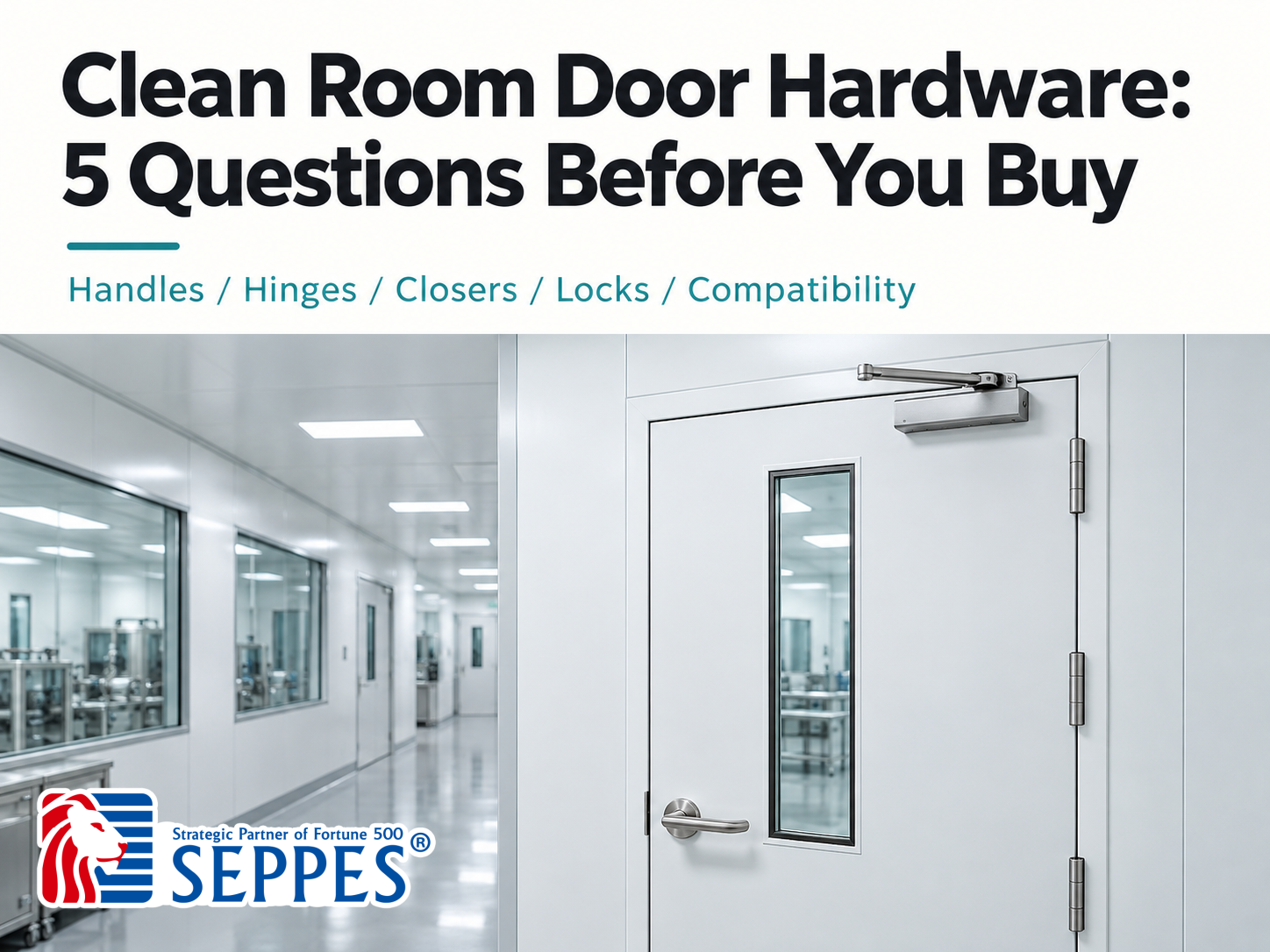

Clean room door hardware shapes how a personnel entrance feels in daily use: how an operator grips the handle, how the leaf moves, and whether it returns to its intended closed position. A door can look appropriate in a drawing while its fittings create awkward hand movements or conflict with the way people approach it.
Consider a purchasing team comparing two similar-looking hinged doors for a clean production corridor. Both quotations show a white leaf and a vision panel. One identifies the hardware models, mounting details and intended operation; the other simply lists “standard accessories.” The difference becomes important when the project team needs to confirm what will actually be supplied.
For a SEPPES project enquiry, these five questions help turn a general request into a usable hardware brief. The focus is a hinged personnel entrance; high-speed rolling doors use a different operating arrangement and need their own component review.
1. Who Will Use the Handle?
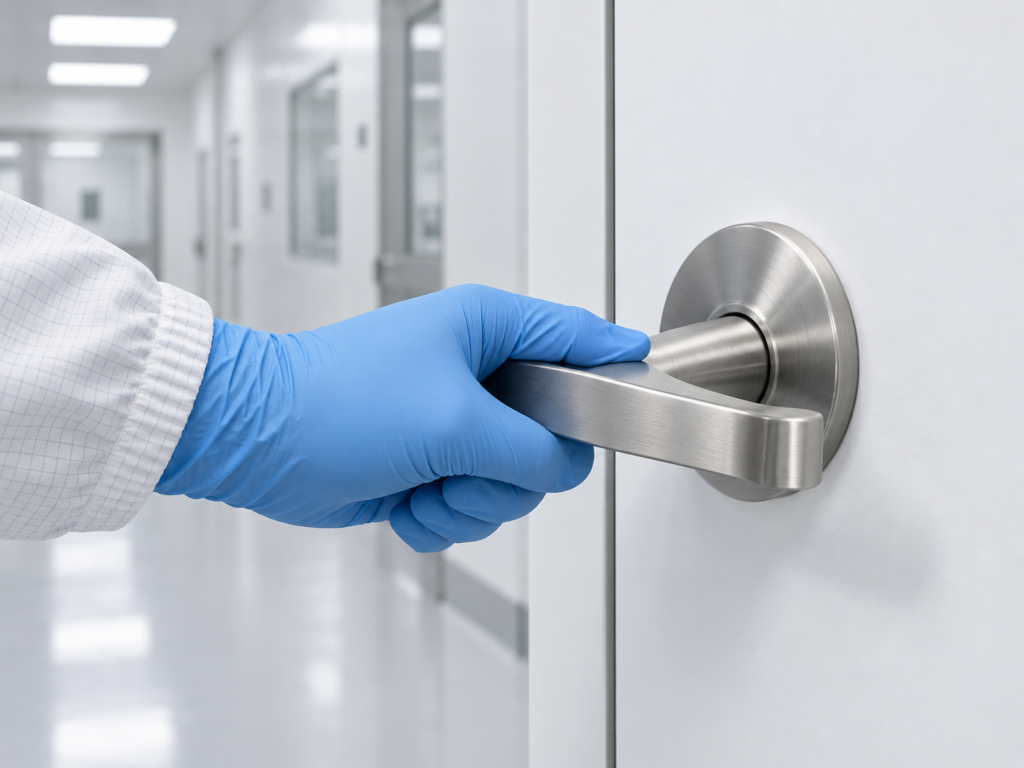
Start with the person at the opening. Will operators wear gloves? Are they approaching from a narrow corridor, carrying a small container, or entering after gowning? These details help the team assess the grip, reach and clearance around a handle. They also reveal situations in which the process needs a different access arrangement.
When comparing clean room door handles, request a sample or a clear dimensional drawing. Check the space between the lever and the door face, the shape of the returning end, and how the rose or backplate meets the leaf. A finish name alone does not explain whether the assembled handle is comfortable to use or accessible for routine wiping.
For US projects with applicable accessibility requirements, the U.S. Access Board’s door guidance addresses one-hand operation and avoiding tight grasping, pinching or wrist twisting. Have the project designer confirm the requirements that apply to the entrance. A gloved-use trial can then help evaluate everyday handling alongside that review.
2. What Must the Hinges Support?
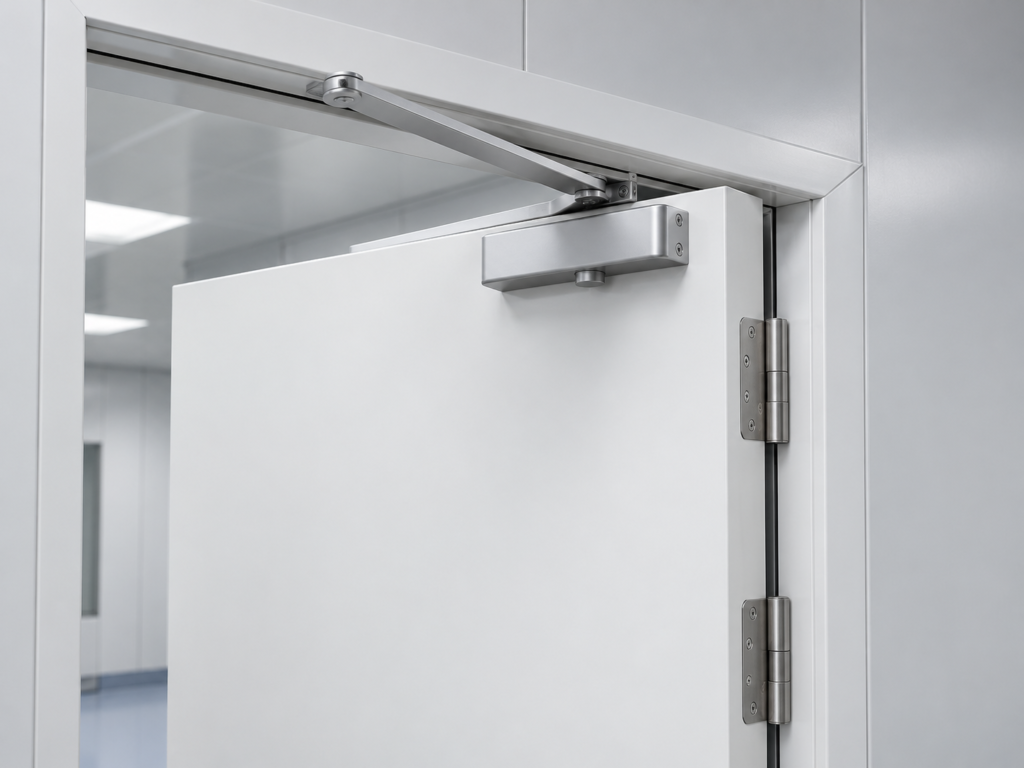
A hinge enquiry needs more than the nominal opening size. Give the supplier the leaf dimensions, construction, finished weight, opening direction and expected use pattern. Include the selected glazing and fitted accessories in the description. Ask for the hinge selection to be checked against the completed door rather than an earlier, lighter version of the design.
For clean room door hinges, ask how the proposed model connects to both the leaf and the frame. The response should identify the fixing arrangement and any reinforcement needed within the selected construction. A robust-looking hinge is not enough information to approve the supporting details hidden behind the finished surface.
Also review the opening arc on the layout. Confirm that the chosen hinge arrangement allows the required movement without the handle or leaf meeting adjacent equipment. Ask how inspection and replacement would be carried out once the wall finishes are complete. This makes maintenance access part of the purchase decision, while the supplier remains responsible for model-specific fitting instructions.
3. How Should the Door Close in Service?
A clean room door closer should be reviewed with the door it will operate. Provide the door size, mounting space and intended closing behaviour. Ask the supplier to identify the proposed unit and arm arrangement on the drawing, including any interference with the vision panel, frame profile or nearby services.
Closing force, closing speed and latching action are different parameters. Manufacturer GEZE’s technical guidance distinguishes them and explains that available settings vary by model. It also identifies seals, sluggish hinges and ventilation influences among possible causes of poor operation. This supports reviewing the assembled entrance before treating every closing problem as a setting issue.
Write an acceptance scenario into the enquiry: an operator passes through, releases the door, and the assembly returns to its specified closed state under the agreed operating conditions. Have the installer and facility team agree how that behaviour will be observed. Record any accessibility constraints and model-specific commissioning requirements in the same brief, so the purchasing decision does not rely on the phrase “adjustable closer.”
4. What Should the Lock Allow?
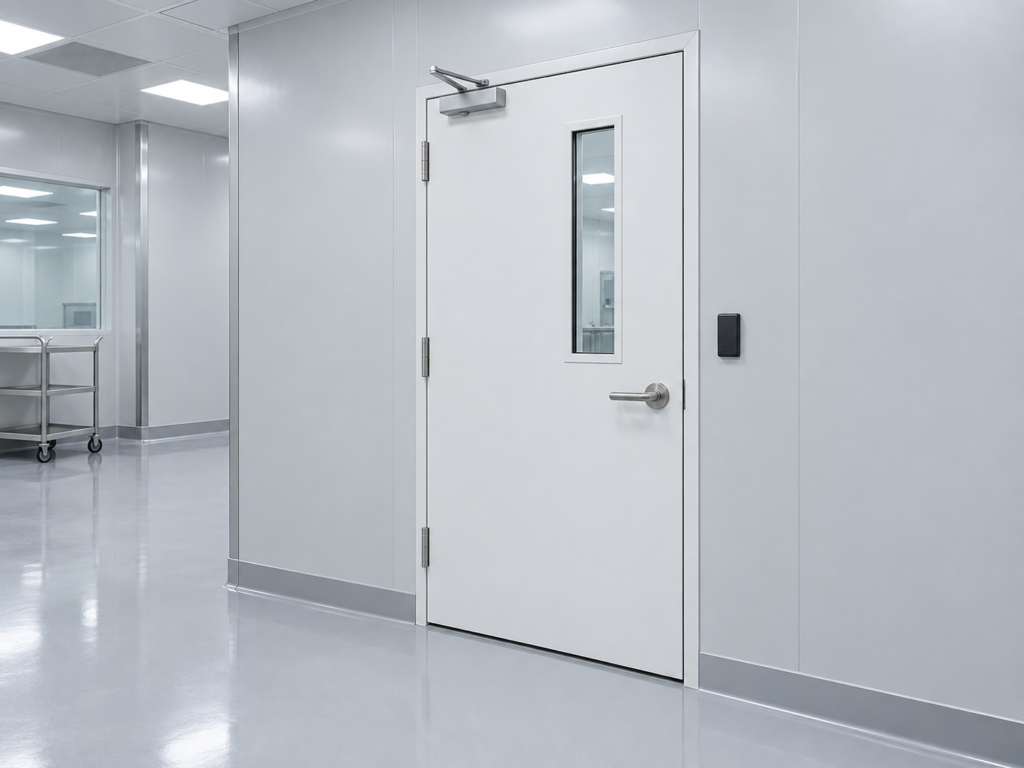
Describe the required behaviour before choosing a clean room door lock. Who may enter from the corridor? How does someone leave the room? Is the entrance mechanically operated, connected to a credential reader, or coordinated with another door? Write these situations separately so the supplier can identify the relevant lock, latch, strike and control interfaces.
A card reader, a locking component and a door-position signal perform different roles. Ask the project team to define what each reported state means. For example, an indication that the leaf has reached the frame should not automatically be treated as proof that every locking component has reached its required position. The monitoring arrangement needs to match the information the process actually uses.
Where the opening forms part of an escape route or a rated assembly, have the responsible designer confirm the permitted hardware combination and release behaviour before procurement. Request a documented operating sequence for the specified configuration, including loss of power if electrical components are involved. This is a project-specific coordination task; a generic lock label cannot establish the complete doorway’s suitability.
5. Does the Clean Room Door Hardware Work as One Set?
Before approving the order, bring the components together in one hardware schedule. For each opening, identify the door reference, handing, handle set, hinges, closer, locking arrangement and finish. Connect that schedule to the latest door drawing. If an item is supplied by another contractor, identify who confirms the interface and who includes it in the final functional check.
Review cleaning compatibility across the actual exposed parts, including handle finishes, hinge covers, closer housings and lock faceplates. Share the facility’s proposed cleaning agents and methods for supplier review. A stainless appearance does not identify every material in the assembly, and matching colours do not establish that all surfaces tolerate the same treatment.
Finally, ask what happens if a listed item becomes unavailable before delivery. Require proposed substitutions to be identified with their mounting and functional differences for review. Keep the approved model references in the handover information. That gives the maintenance team a useful starting point when ordering replacements instead of relying on a photograph of similar-looking hardware.
Bring a Coordinated Door Brief to SEPPES
SEPPES presents hinged personnel doors alongside high-speed door options for controlled production environments. Start with the SEPPES cleanroom door systems and access solutions overview to place each entrance within the wider facility plan, then discuss the hardware appropriate to the selected door model.
For a more useful enquiry, send the opening schedule, wall details, traffic description, cleaning method and required access sequence. Ask SEPPES to confirm the proposed configuration, supply boundaries and unresolved interfaces in the quotation. The result should be a clearly described entrance that the purchasing, installation and operations teams can all review against the same requirements.
