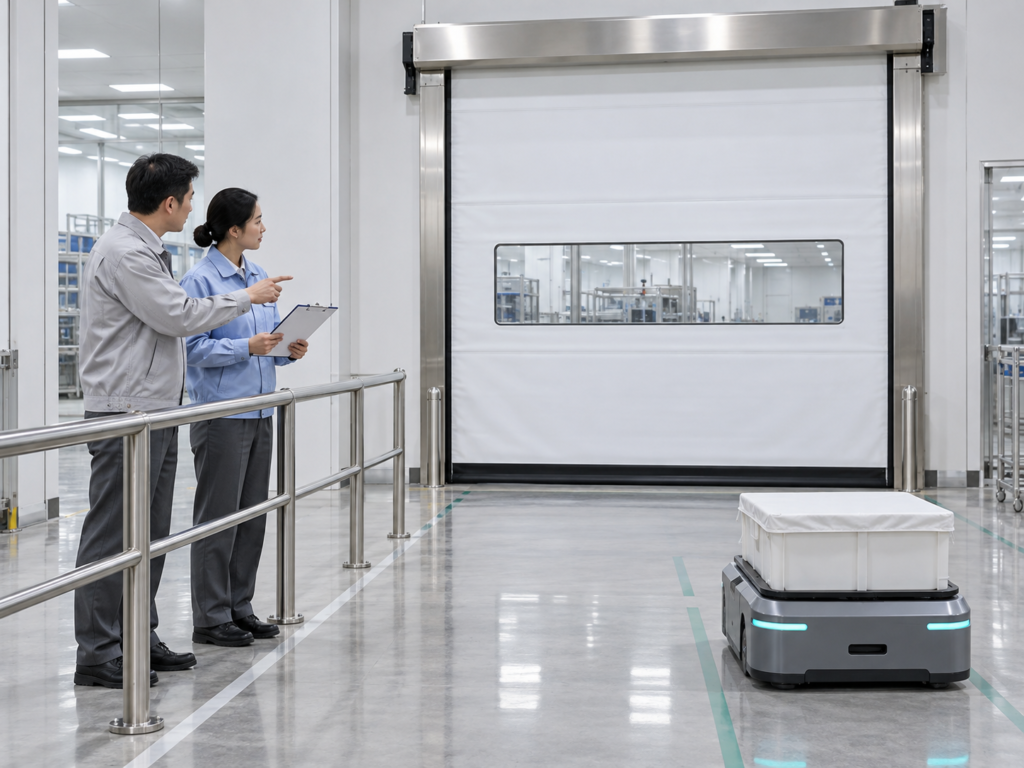

A rapid door on an automated material route needs to do more than open when a vehicle arrives. Imagine an autonomous mobile robot carrying a covered tote towards a cleanroom entrance. The robot reaches its waypoint, but the door is unavailable because another transfer is still in progress. Where should it wait, and what tells it that passage is genuinely available?
That hypothetical situation connects three decisions: which equipment may cross the cleanroom boundary, how traffic is coordinated, and how the installed system protects people. Whether the project uses automated guided vehicles (AGVs) or autonomous mobile robots (AMRs), the door, vehicle and facility teams need a shared plan. These six questions provide a practical starting point for a SEPPES specification.
1 Should the Vehicle Cross the Rapid Door Boundary
Begin with the transfer method. A vehicle that serves a warehouse does not automatically belong inside a controlled production area. The load, outer packaging, wheels, body surfaces and cleaning access all deserve review. Decide whether the complete vehicle enters, a dedicated vehicle serves each side, or material is handed over at a defined transfer point.
For sterile medicinal product facilities, EU GMP Annex 1 identifies equipment and material transfer as a significant contamination concern. That makes the transfer assessment part of the process design, not something resolved by choosing a faster door. Other industries should use their own applicable contamination-control requirements. EU GMP Annex 1, section 4.10. Write the agreed boundary on the layout. Identify the permitted load condition and any preparation required before transfer. This gives SEPPES a clear opening duty and prevents an automation proposal from quietly changing the site’s approved material flow.
2 Where Will the Loaded Robot Wait and Turn
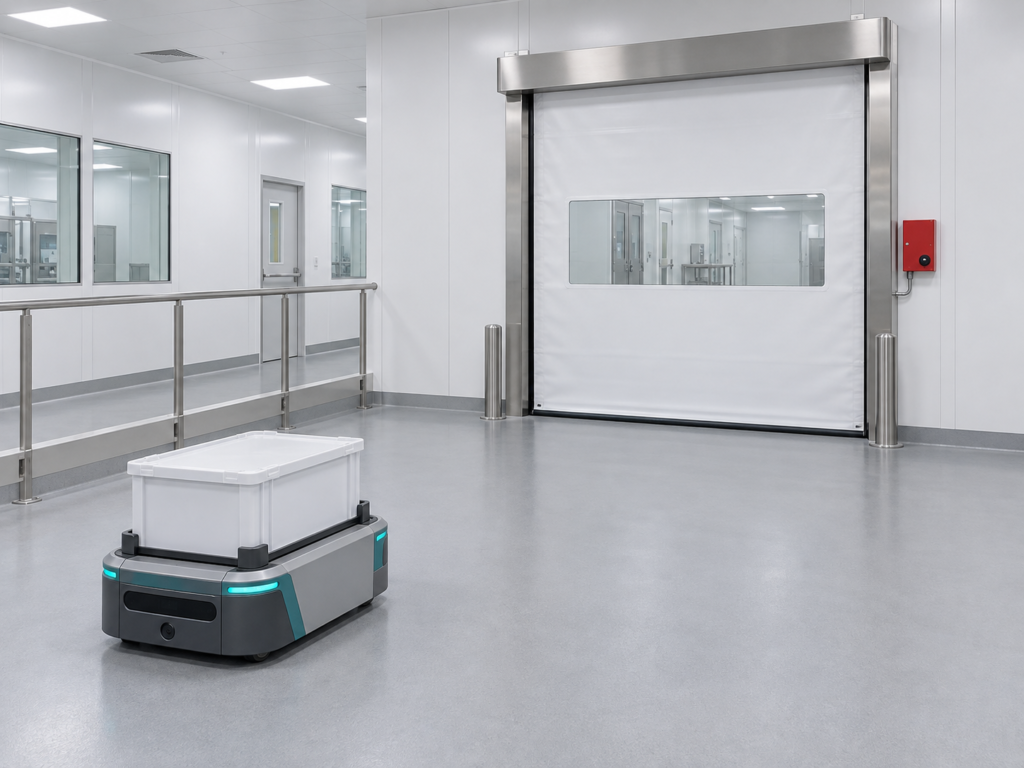
Lay out the route using the complete moving load, including overhangs and any trailer. Check the approach, turning movement, usable opening and space beyond the doorway. A robot chassis that fits through an opening does not prove that every approved load can follow the same path. When specifying high speed roll doors, show the proposed waiting location separately from the passage. Review whether a stopped vehicle would obstruct another route, a pedestrian entrance or access needed for maintenance. Ask the robot integrator to assess the approach and stopping requirements for the actual vehicle and environment; do not select a universal waiting distance.
People still enter automated areas for inspections, cleaning and recovery. HSE’s workplace transport guidance recommends separating pedestrians and vehicles and specifically addresses trapping risks where people share routes with driverless vehicles. Use that principle in the layout review, alongside applicable local requirements. HSE pedestrian safety guidance. Check the route again with the door open and closed. Nearby equipment, door guides and changes in the visible scene should be included in the integrator’s navigation assessment.
3 What Information Must the Door and Robot Exchange
Describe the operating sequence before choosing a connection method. The vehicle’s request to pass, the door’s position, the route’s availability and confirmation that the complete load has cleared are different pieces of information. Assign an owner and a definition to each. A request acknowledgement should not be interpreted as permission to enter.
| Information to define | Question for the integration team |
|---|---|
| Passage request | Which vehicle or route is requesting access? |
| Opening available | What conditions must be confirmed before movement? |
| Transfer complete | How is clearance of the complete load established? |
| Unavailable or fault | Who receives the condition and manages the response? |
This is a discussion framework, not a safety circuit. Safety-related functions need separate assessment and verification by the competent integration team. ISO 3691-4 covers driverless industrial trucks and their systems, including AGVs and AMRs, and highlights the significance of the operating zone. Its scope excludes additional hazards arising from specific hygienic requirements, so it cannot replace the cleanroom assessment. ISO 3691-4 public overview. Confirm the interfaces available on the proposed SEPPES configuration. Do not assume a particular network protocol, fleet-manager connection or safety-rated output is standard.
4 How Will the Robot Coordinate with an Airlock
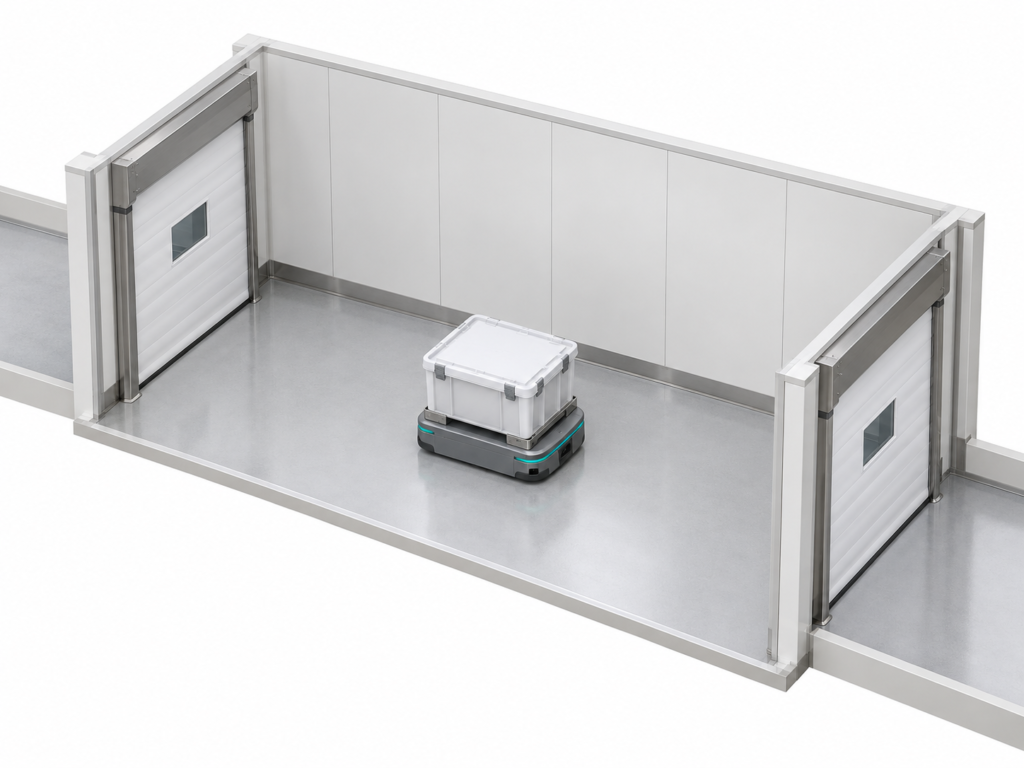
If the route passes through two doors, review the entire transfer space. The vehicle and its approved load must fit in the intended waiting position without occupying either doorway. Define how access is requested, which conditions make the next stage available and what happens when the destination cannot receive the load. In sterile medicinal product facilities, Annex 1 addresses non-simultaneous opening of airlock doors and distinguishes interlocking requirements by the areas served. Where a delay is needed for segregation, it must be established for that purpose. Robot travel time is not evidence that the room has recovered. EU GMP Annex 1, section 4.13.
SEPPES’s cleanroom-door catalogue describes interlock logic, a zipper-guided curtain and a flush vision panel. These provide useful details for a coordinated door specification. If purchasing is seeking an airtight high speed door manufacturer, require the proposed sealing evidence and the agreed control sequence to be reviewed separately. An interlock does not prove leakage performance, and neither establishes the full transfer process.
5 What Happens When a Normal Transfer Cannot Finish
Plan exceptions before routine operation begins. Review loss of communication, a door that fails to reach its required position, a vehicle stopped in the transfer space, unavailable destination space and a maintenance lockout. The correct response depends on the complete risk assessment and the vehicle and door manufacturers’ instructions. For speed roll up doors on an automated route, agree how an unavailable doorway is communicated to the fleet controller and the people responsible for recovery. Avoid an arrangement where repeated requests conceal a fault or leave several vehicles waiting around an occupied entrance.
Recovery may bring people into a space normally used by robots. Define who can authorize intervention, how the area is made safe and what checks are required before returning it to service. Do not bypass protective functions to release a delayed delivery. Keep the recovery instructions accessible and train the responsible team before handover.
6 What Should a Joint SEPPES Acceptance Review Include
When comparing high speed roll up door manufacturers, request a defined supply boundary rather than a general statement that a door is automation-ready. Identify who supplies the interface components, who configures the sequence and who verifies the completed installation. Record any exclusions before the purchase order is approved. Build the acceptance plan around representative approved loads, both travel directions where allowed, normal waiting and defined exception scenarios. The competent team should choose safe test methods, including simulation where appropriate. Record results against agreed criteria instead of treating one successful empty-vehicle pass as completion.
Send SEPPES the route drawing, vehicle and load envelopes, contamination-control requirements, cleaning method and interface brief. Review the proposed door model with the robot integrator and facility team, then agree the documents and site checks needed for handover. A rapid door works best in an automation project when its duty is explicit. With a shared transfer plan, the SEPPES discussion can focus on the appropriate construction, confirmed control options and practical access for inspection, rather than discovering missing responsibilities after installation.