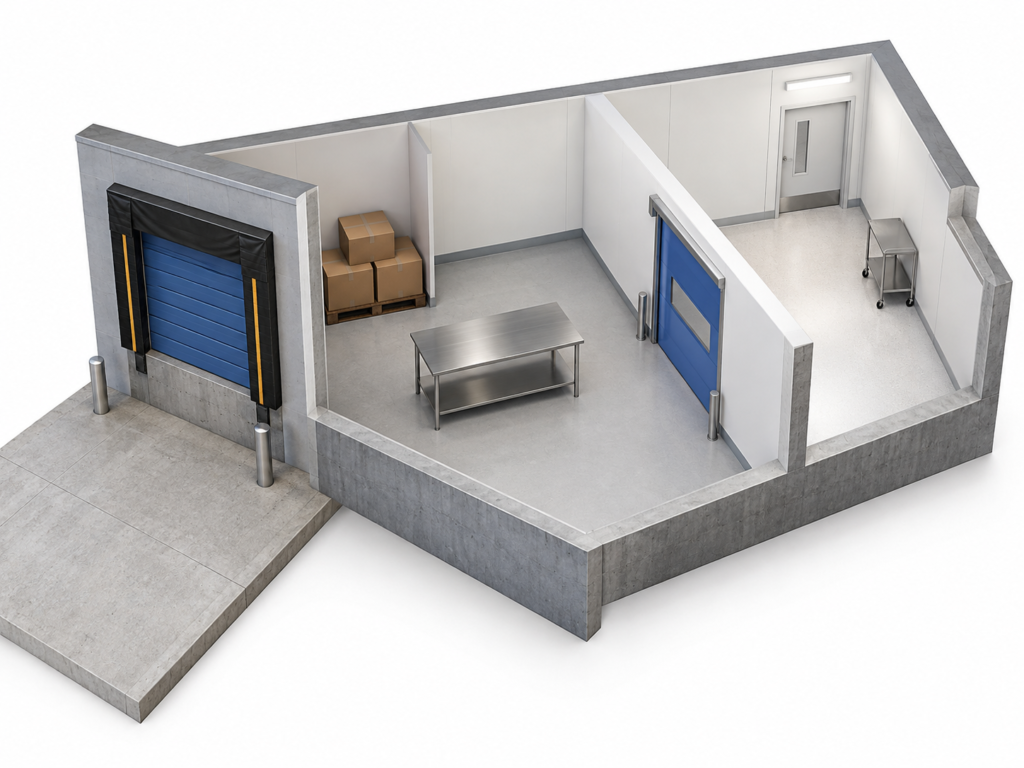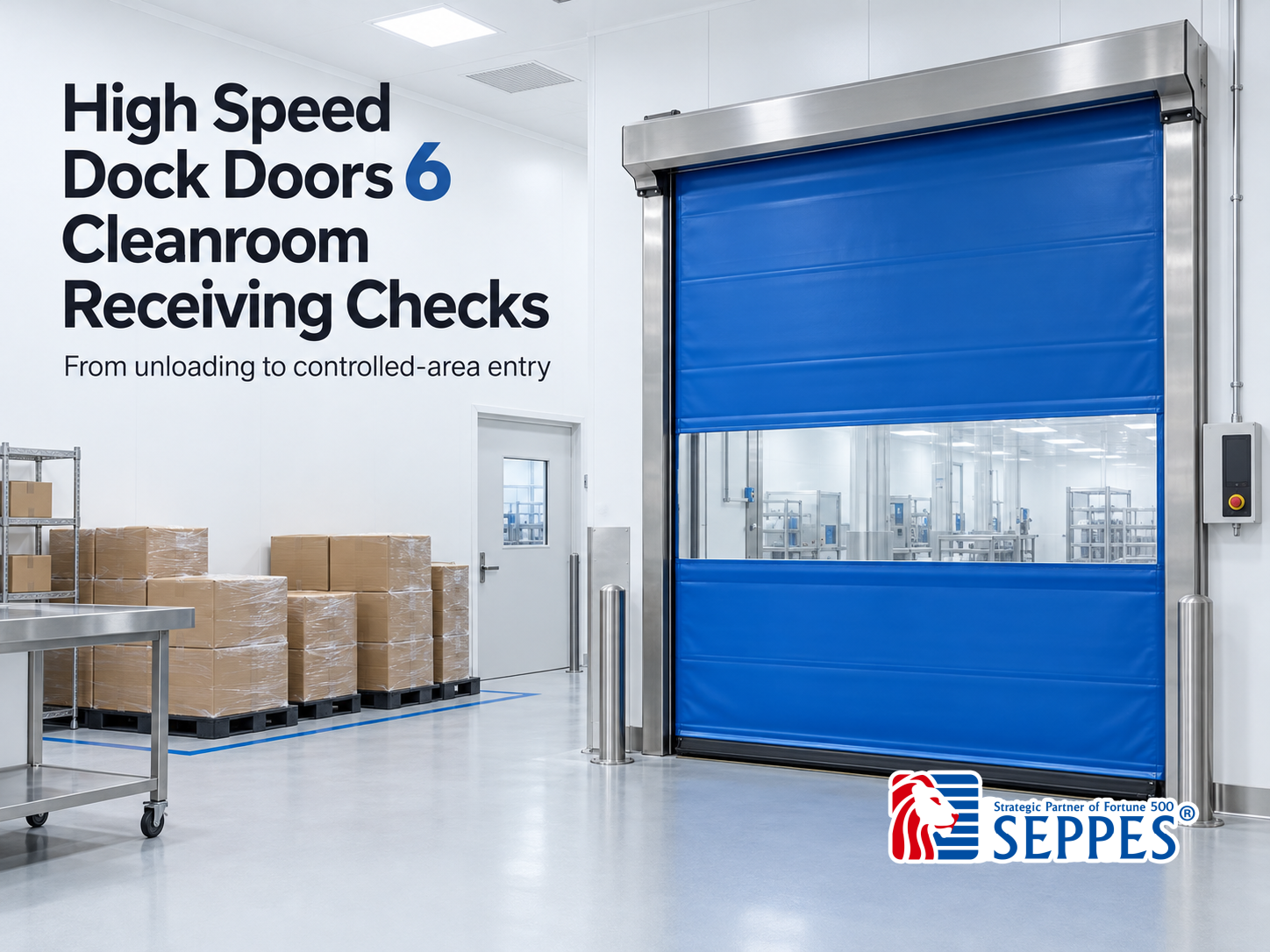

High speed dock doors should be planned around what happens to incoming goods before they reach a cleanroom. Unloading a vehicle, accepting a delivery and approving material for controlled-area entry are different events. A faster doorway cannot turn them into one step.
Consider a pallet that arrives with damp outer wrapping while the preparation area is already occupied. The truck may be ready to unload, but the material still needs an appropriate place for inspection and handling. For a SEPPES project, the useful starting point is the complete receiving route: where the shipment arrives, where its condition and status are checked, and where the controlled transfer begins.
1 Define Where High Speed Dock Doors Fit
Mark the exterior opening, receiving area, preparation space and controlled-area entrance on the same drawing. Give each boundary a stated purpose. The dock opening may need to accommodate unloading and weather exposure; the internal entrance may serve a prepared-material transfer process. Treating both as a single door requirement can leave a missing step between them.
Ask what crosses each boundary, including the pallet, wrapping, transport equipment and personnel accompanying the load. The answer may change along the route. For example, goods might arrive on a delivery pallet and continue on a site-approved cart after the specified preparation. That arrangement must come from the facility’s process, not from the door supplier’s assumptions. Keep the receiving area separate from the cleanroom classification discussion unless its status has actually been defined. An enclosed loading bay is not automatically a cleanroom, and a second door does not by itself create a qualified airlock.
2 Review Weather Protection With and Without a Truck
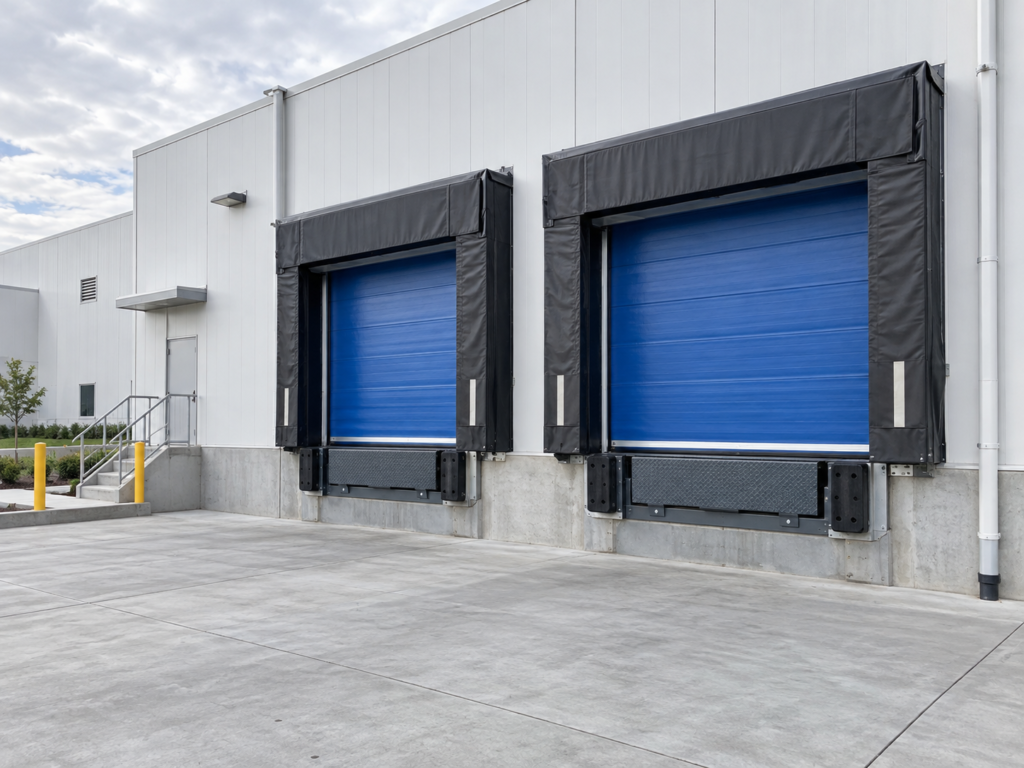
An external high speed door has to suit the conditions at its actual opening. Review the doorway when no vehicle is present, during docking and throughout unloading. A shelter that fits one trailer arrangement may leave different gaps around another. Supply vehicle information and relevant site exposure conditions before the assembly is selected. For human-medicinal-product facilities applying EU GMP, Chapter 3 section 3.20 addresses weather protection at receiving and dispatch bays and provision for cleaning incoming containers where necessary. That is a pharmaceutical requirement context, not a claim that a particular door makes every receiving area compliant. EU GMP Chapter 3
SEPPES’s 2026 catalogue presents industrial doors, dock shelters and dock levelers as a coordinated loading arrangement. Discuss those components together, while confirming the model and operating sequence for your opening. Their combined role at the truck interface remains distinct from the downstream cleanroom boundary. Do not use an exterior weather barrier as the sole justification for internal environmental protection.
3 Reserve Space for Inspection and Packaging Decisions
The receiving layout should give staff somewhere to assess a load before it joins the next transfer. Define the location for checking delivery identity, visible packaging condition and any status required by the site’s receiving procedure. Include a designated response for damaged or wet packaging so that the cleanroom entrance does not become an improvised inspection station.
Agree which packaging layers may continue, which need preparation and which must be removed before the next boundary. These decisions depend on the product and approved handling method. Do not apply a blanket rule about all cardboard or all pallets without checking the actual process. Removing a transport layer also must not expose material that needs to remain protected. Record where removed packaging leaves the work area and how waiting material remains identifiable. If sampling is required, include its approved location in the route review. Buying high speed industrial roll doors will not resolve missing inspection space or an unclear decision about where unaccepted material should wait.

4 Separate Delivery Traffic From Controlled Transfer
Decide where responsibility passes from the delivery operation to the internal team. Visiting drivers, unloading vehicles and clean transfer carts may have different permitted routes. A convenient straight line through the building is not sufficient reason to give them the same access. UK HSE loading guidance calls for separation from unrelated traffic and people, advance agreement between the parties involved, and safeguards against premature vehicle departure. Those transport controls need their own assessment alongside contamination-control arrangements. HSE loading guidance
For the internal handover, specify the load envelope and the equipment used on each side. A pallet may fit through the opening while the operator lacks space to turn or complete the handover. Walk through the proposed movement with logistics and production representatives, including where delivery equipment stops and where the next operator receives the load. If the receiving team cannot accept the next shipment, define where it waits and who communicates the restriction. Do not make the internal door threshold the default place to hold a delivery while staff look for available space.
5 Coordinate Door Requests Around the Receiving Process
The outside opening may remain in use during a truck unloading session while the internal transfer door serves individual loads. Map those operating states before deciding whether the doors need any coordinated logic. Two doors on the same route do not necessarily need identical timing or a universal rule that only one can ever open. An automatic high speed roll up door responds to its configured control system. The project still needs to define who may request entry, which process conditions matter and what happens when the next area is unavailable. Where interlocking is required, agree the sequence and fault response with the controls and facilities teams.
SEPPES’s cleanroom-specific catalogue model includes coordinated-door interlock logic, zipper-guided construction and a flush vision panel. These are useful configuration points to review for the internal boundary. Confirm the actual interfaces and site requirements rather than assuming a catalogue option completes the integration. The facilities team should also review how the planned opening states affect the required environmental conditions; no fixed delay can be selected from door speed alone.
6 Give SEPPES a Complete Receiving Brief
Prepare one layout showing the receiving route and a short schedule describing the role of each opening. Include the expected vehicles and loads, the preparation step before controlled entry, relevant environmental conditions and responsibility for the equipment interfaces. This lets logistics, quality and engineering review the same proposal. When comparing clean room high speed doors for sale, ask which assembly is proposed for the internal opening and why. Keep that decision separate from the dock-door selection, even if both are discussed with SEPPES. The right comparison is between specified configurations serving defined tasks, not photographs with similar curtain colors.
Before approval, walk through an ordinary delivery and a delayed acceptance. Check where the load stops, whether its status remains clear and which door requests are permitted at each stage. Assign unresolved questions to the responsible team rather than leaving them for operators to interpret after installation. Send SEPPES the route drawing, opening measurements and receiving requirements to request a configuration review. A well-defined brief connects the exterior loading arrangement with the internal cleanroom door while preserving the purpose of each boundary.