


Cleanroom door storage needs a plan when equipment arrives before the opening is ready. Here, storage means looking after the delivered door assembly and its components while they await installation, not choosing a door for a storage room. The practical priorities are a suitable location, clear responsibility and a recorded handover.
Imagine a project where wall finishing is delayed but the door shipment is already on its way. The delivery team needs somewhere to put the packages, another trade wants the same floor space, and the installer is scheduled for the following week. Without an agreed arrangement, the equipment may be moved repeatedly and its condition becomes harder to track. A three-stage approach makes the waiting period easier to manage: receive the correct equipment, preserve it during the delay, and release it to an installation team when the site is ready. This is a planning framework; the supplied model’s handling and storage instructions remain essential.
Stage 1: Plan Cleanroom Door Storage Before the Truck Arrives
Begin with the delivery date, package list and available space. A long guide package or head assembly may need a different route from a small control enclosure. Ask SEPPES for the package information and handling instructions applicable to the order, then share them with the receiving and installation teams. A cleanroom door handling plan should identify who coordinates unloading, what competent personnel and suitable equipment are needed, and where the load will wait. Do not leave the driver to discover that the intended area is occupied. The UK’s HSE delivery guidance emphasises advance cooperation between supplier, carrier and recipient; use local safety requirements and a site-specific assessment for the actual operation.
At receipt, carry out a cleanroom door delivery inspection against the packing list and the project’s agreed procedure. Record package identity, quantities and visible condition. Note damaged wrapping, signs of wetting or an apparent impact without assuming that an intact outer box proves the contents are undamaged. Where unpacking is required for inspection, agree a suitable place and method beforehand. Record photographs and discrepancies, retain relevant identification, and contact the appropriate supplier or carrier contact through the agreed process. Receipt of a shipment is not the same decision as accepting it for installation.
Keep uncertain items identifiable and out of the installation release until their condition has been assessed. Avoid improvised straightening, repairs or powered tests simply to find out whether a component still works. Those actions need the responsible technical team’s direction.
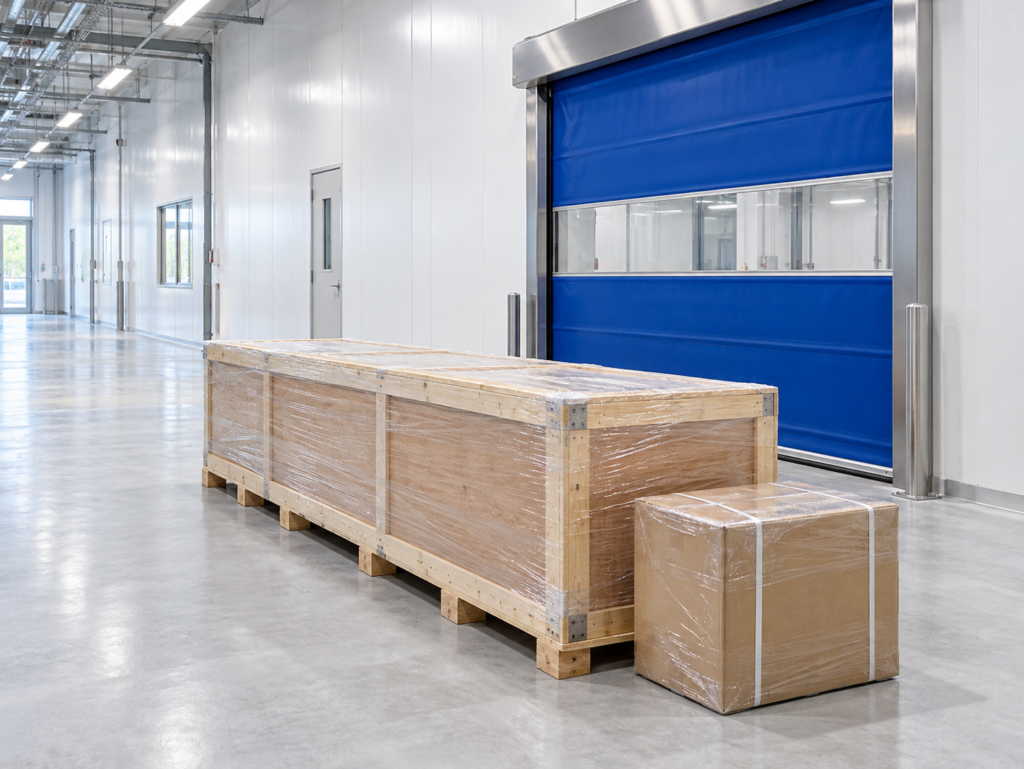
Concept illustration of a receiving area, not an unloading method or an actual SEPPES delivery.
Stage 2: Preserve the Equipment While Other Work Continues
Select a designated holding area that matches the manufacturer’s instructions and can remain available for the expected waiting period. Consider exposure to weather, building leaks, dust-producing work, cleaning activity and passing traffic. The space should not obstruct access or escape routes. HSE’s construction storage guidance recommends planned storage areas and keeping pedestrian routes clear. Do not invent a universal temperature, humidity limit or stacking height for all cleanroom doors. The assembly may include a curtain, seals, drive components and electronics with different needs. Obtain the relevant limits and storage orientation for the supplied items, including any conditions that apply if the delay becomes longer than expected.
Cleanroom door packaging protection should continue after the delivery inspection. Preserve or reinstate the protection specified for the equipment, keeping identification accessible. Do not assume that transport packaging is suitable for prolonged outdoor exposure, or that adding an extra sealed cover is an appropriate response to wet material. Keep each opening’s components together through a package register or clearly linked locations. A control enclosure, sensor kit and fixing pack may arrive separately from the main assembly. If parts are temporarily removed for review, record who has them and where they will be returned. Avoid using a door package as a workbench or a support for unrelated materials.
Nominate someone to check the holding area at an interval suited to the site risk and after relevant events, such as a leak, relocation or nearby wet work. Record changes in condition rather than relying on memory. If protection is damaged or moisture is suspected, obtain instructions for assessment and recovery before rewrapping or moving the item into a cleaner area.
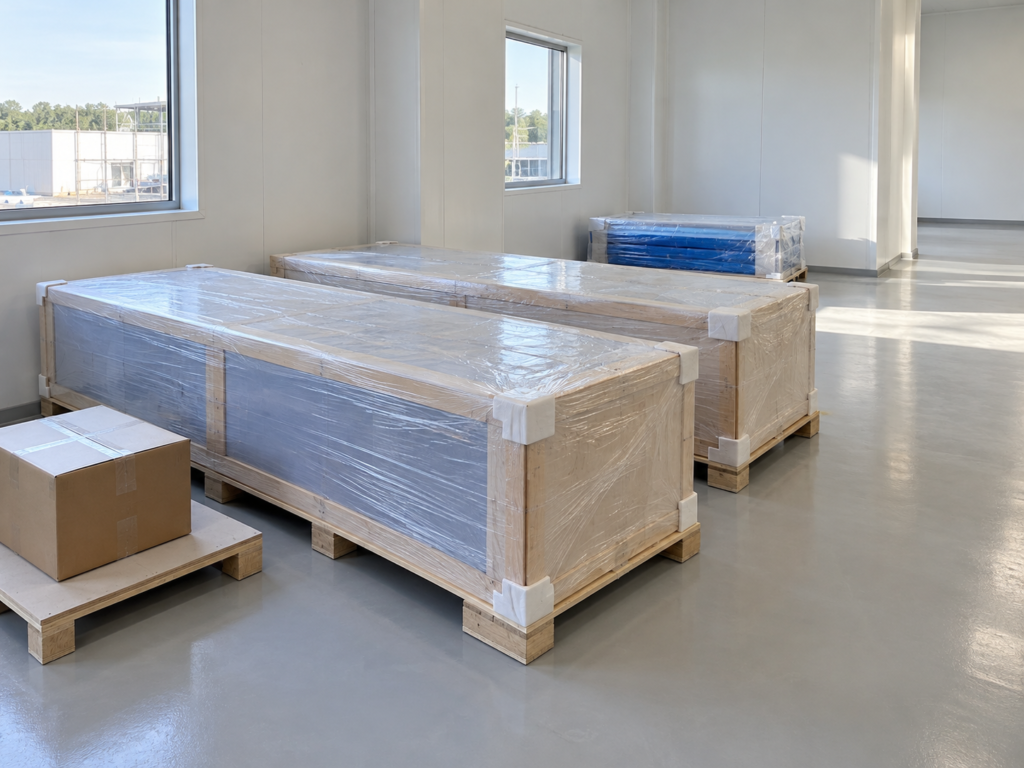
Illustrative storage arrangement; actual supports, orientation and protection must follow supplier instructions.
Stage 3: Hand Over to Installation When the Site Is Ready
A calendar date alone does not establish cleanroom door installation readiness. Review the actual opening, the agreed mounting details, the work area and the route from storage. Check that required supporting work and relevant services are at the stage agreed with the installer, and that unresolved site changes have been addressed. Reconcile the stored packages with the intended door tag and current accepted configuration. Review any inspection findings, substitutions, missing items or storage incidents. A change made during the waiting period should be visible to the installation team, not buried in a message sent only to purchasing.
Plan the transition from construction storage to the installation area. Decide where outer packaging will be removed, how waste will leave, and what preparation the site’s cleanliness procedure requires. Do not treat a covered or visibly clean package as sterile. The cleaning method must suit both the component materials and the site’s process. Complete a short handover record identifying the equipment, its observed condition, any remaining actions and the person taking responsibility. Storage release is not a substitute for installation checks, commissioning or the facility’s own acceptance process. It simply makes the starting condition and outstanding issues clear.
Concept illustration of installation readiness, not an approved layout or installation procedure.

When the Project Programme Changes
Suppose the installation is postponed again and the original holding area is needed by another trade. This is a new storage decision, not just a scheduling note. Review the proposed location, any additional handling and the duration with the supplier and site team before the packages are moved. The table below gives examples of issues to resolve. It is not a product-specific preservation procedure, and it does not establish warranty conditions.
| Change | Question to resolve | Record to retain |
|---|---|---|
| Longer installation delay | Do the existing storage arrangements remain suitable? | Supplier guidance and revised review date |
| Move to another holding area | Can the packages be handled and supported as specified? | New location and condition check |
| Wet or damaged protection | What assessment is needed before further handling or release? | Photographs, advice and disposition |
| Partial installation | Which components remain in storage and who controls them? | Updated package register and ownership |
Coordinate the Delivery Plan with SEPPES
Discuss the expected installation window when reviewing the SEPPES cleanroom door systems and access solutions. Share the site constraints as well as the opening requirements. A project that cannot provide suitable temporary storage may need a different delivery arrangement, subject to manufacturing and logistics availability.
Before dispatch, ask SEPPES to confirm the applicable packing information, handling guidance, storage instructions and contact route for delivery concerns. Agree who will coordinate with the carrier, who receives the equipment and who hands it to the installer. Keep the instructions with the package records so they remain available when site personnel change. The aim is straightforward: the correct door components should reach the correct opening with their identity, condition and responsibilities understood. Planning the period between delivery and installation helps preserve the decisions already made during selection and gives the installation team a clearer starting point.
Images are AI-generated concept illustrations, not actual SEPPES deliveries, approved storage arrangements or installation instructions.
