
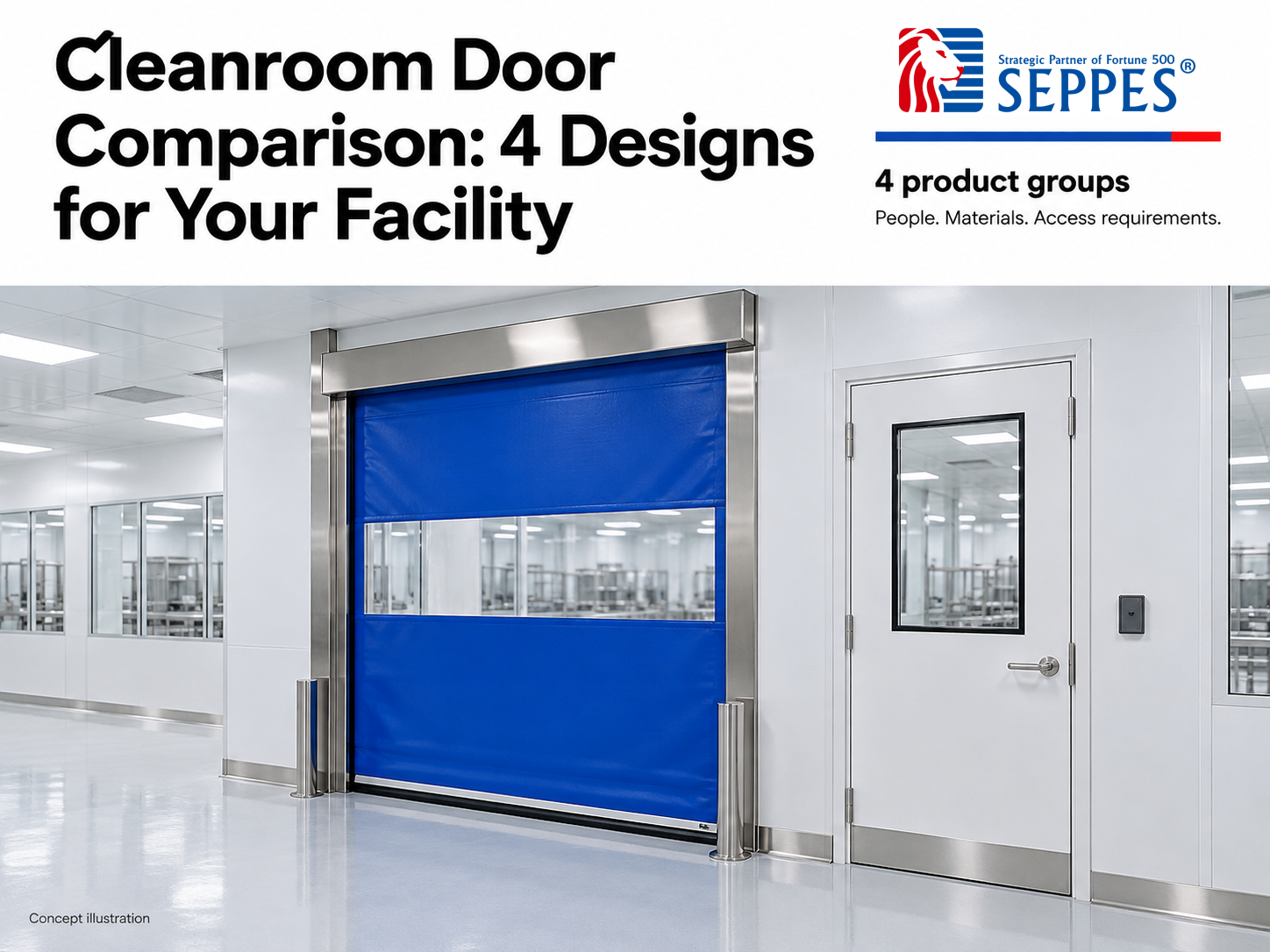

A cleanroom door comparison becomes useful when it starts with the opening, not a list of product names. A doorway used by staff between changing areas has a different job from one carrying loaded trolleys into a material buffer room. Giving both openings the same door can leave the actual workflow unresolved.
SEPPES presents four product groups for these decisions: stainless steel high speed doors, PVC high speed doors, self-repairing high speed doors and cleanroom swing doors. These labels describe different aspects of a door. Stainless steel refers to specified components, PVC to the curtain material, self-repairing to a recovery function, and swing to the opening movement.
This guide explains how to shortlist them without treating every feature as a separate, competing technology. For an overview of the range and related access requirements, explore the SEPPES cleanroom door systems.
Start the Cleanroom Door Comparison with the Route
Write down who or what crosses the opening, what conditions exist on either side, and what must happen before access is allowed. Include the loaded size of a trolley, its turning approach and any waiting space. A nominal wall opening alone does not describe the usable route.
Then separate essential requirements from preferences. Examples include a defined cleaning method, an agreed pressure strategy, access-control permissions or coordination with another door. A preferred curtain colour can be decided later. Requirements that affect layout or equipment interfaces need attention before the design is fixed.
Use the following table to form a shortlist. It is a discussion framework, not a cleanroom classification or an approval for a particular application.
| Product group | Useful starting point | Key question before selection |
|---|---|---|
| Stainless steel high speed | Material routes with defined cleaning requirements | Which components and steel grades are included? |
| PVC high speed | Frequent internal goods movement | Does the guide and seal arrangement suit this boundary? |
| Self-repairing high speed | Routes where curtain dislodgement is a concern | What can reset, and what still requires inspection? |
| Cleanroom swing | Personnel access and room partitions | Does the leaf movement fit the route and access needs? |
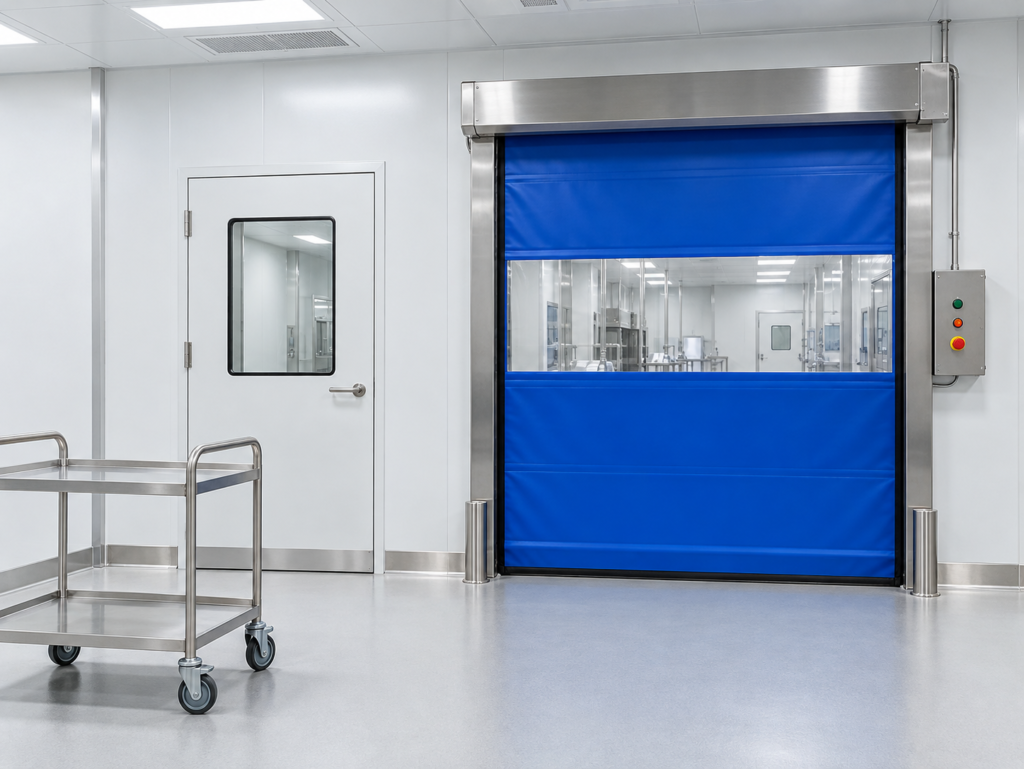
1. Stainless Steel High Speed Doors: Specify the Assembly
Consider this group when component materials and access for cleaning are important to the opening. A stainless steel frame or housing can be relevant to the project, but the description should identify the actual parts supplied. It should not leave the buyer assuming that every fastener, bracket and enclosure uses the same material. Good cleanroom door material selection also covers the curtain, viewing panel, seals and controls. Share the cleaning products, application method and frequency with the supplier. Ask for compatibility information for the proposed assembly, including components that sit outside the obvious frame.
For example, a trolley route between a preparation area and a controlled production room may need a material review alongside its sealing requirements. The stainless steel option provides a starting configuration to examine. It does not remove the need to confirm the surrounding wall connection, lower edge and installation details.
2. PVC High Speed Doors: Examine the Guide Arrangement
A flexible PVC curtain can be considered for repeated internal goods movement. The next question is how the curtain is guided and how the opening is finished. A packing-area passage and a pressure-managed production boundary should not be treated as equivalent simply because both are indoors. When comparing brush seal vs zipper door guides, request drawings or clear photographs of the proposed construction. Review the guide interfaces, bottom closure and access for maintenance. Ask what happens when brushes wear, a curtain edge is displaced or the surrounding opening is out of alignment.
Where leakage matters, request evidence that identifies the tested configuration and conditions. Do not convert a guide description into an assumed room rating. ISO 14644-1 classifies air cleanliness by airborne particle concentration; the practical implication is that a door material or guide label alone cannot establish that classification.
3. Self-Repairing High Speed Doors: Define the Recovery Limits
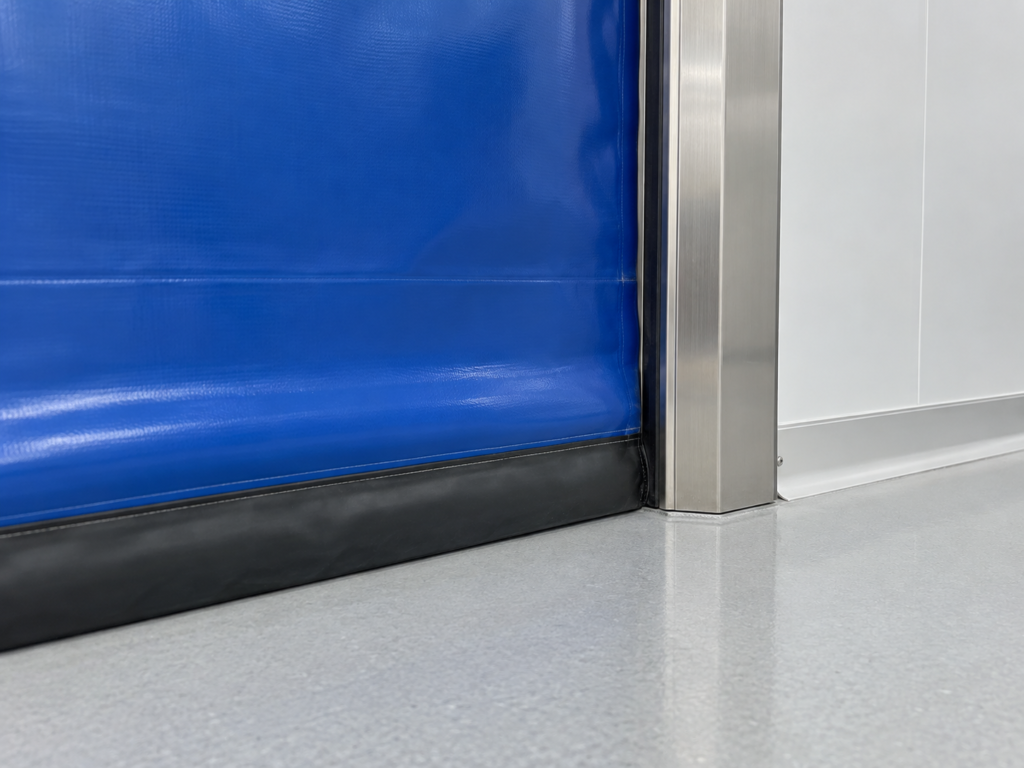
The term self-repairing deserves a precise explanation. On equipped models, it refers to the curtain reinsertion function after a recoverable displacement. It is not a promise that torn fabric, bent guides or damaged safety devices repair themselves. Ask SEPPES to confirm whether the proposed model includes this function, the conditions under which it operates, and the inspection procedure after an incident. The operational question is not only whether the curtain returns to its guide. It is also whether the opening is safe to release back into service.
This feature may be relevant where trolley handling creates a credible risk of curtain dislodgement. It should sit alongside adequate clearance, traffic management and suitable detection. Selecting a recovery function is not a substitute for correcting a route that repeatedly directs loads into the doorway.
4. Cleanroom Swing Doors: Plan Around People
A hinged door can be the appropriate starting point for staff entrances, changing-room connections and room partitions. The useful comparison is not simply fast versus slow. It is whether the movement, access method and available space suit the person using the opening. For cleanroom personnel door planning, check the leaf sweep against nearby doors, waiting positions and circulation space. Review the viewing window, handle or activation method, closer and access-control arrangement. Accessibility, emergency escape and any required fire performance need separate confirmation for the applicable project.
Consider a corridor serving both staff and material deliveries. Separate personnel and goods entrances may be worth assessing where the layout allows them. Staff would not need to use the larger opening for every routine passage. This is an illustrative planning option, not a claim that two doors are always necessary or that a particular saving will result.
Turn the Shortlist into a SEPPES Project Brief
Once the product group is clear, describe how the opening must behave. If it works with another door, specify the intended sequence. If it serves automated equipment, identify the access request, open confirmation and fault response that the project team needs to coordinate. Confirm the available interfaces for the selected controller. A useful cleanroom door project brief brings the decisions together: clear width and height, quantity, wall construction, side space, headroom, traffic type, cleaning conditions and control requirements. Mark unknown items as pending rather than filling them with assumptions. Add site photographs and a route sketch where available.
Return to the SEPPES cleanroom door manufacturer overview to review the product groups, access solutions and project enquiry section together. Share the opening information with the team so the proposed configuration can be checked against your process before manufacture. The result should be a door schedule that explains why each opening has its selected configuration. A consistent buying process does not require every doorway to have the same door.
Images are AI-generated concept illustrations, not actual SEPPES installations or evidence of certified performance.
