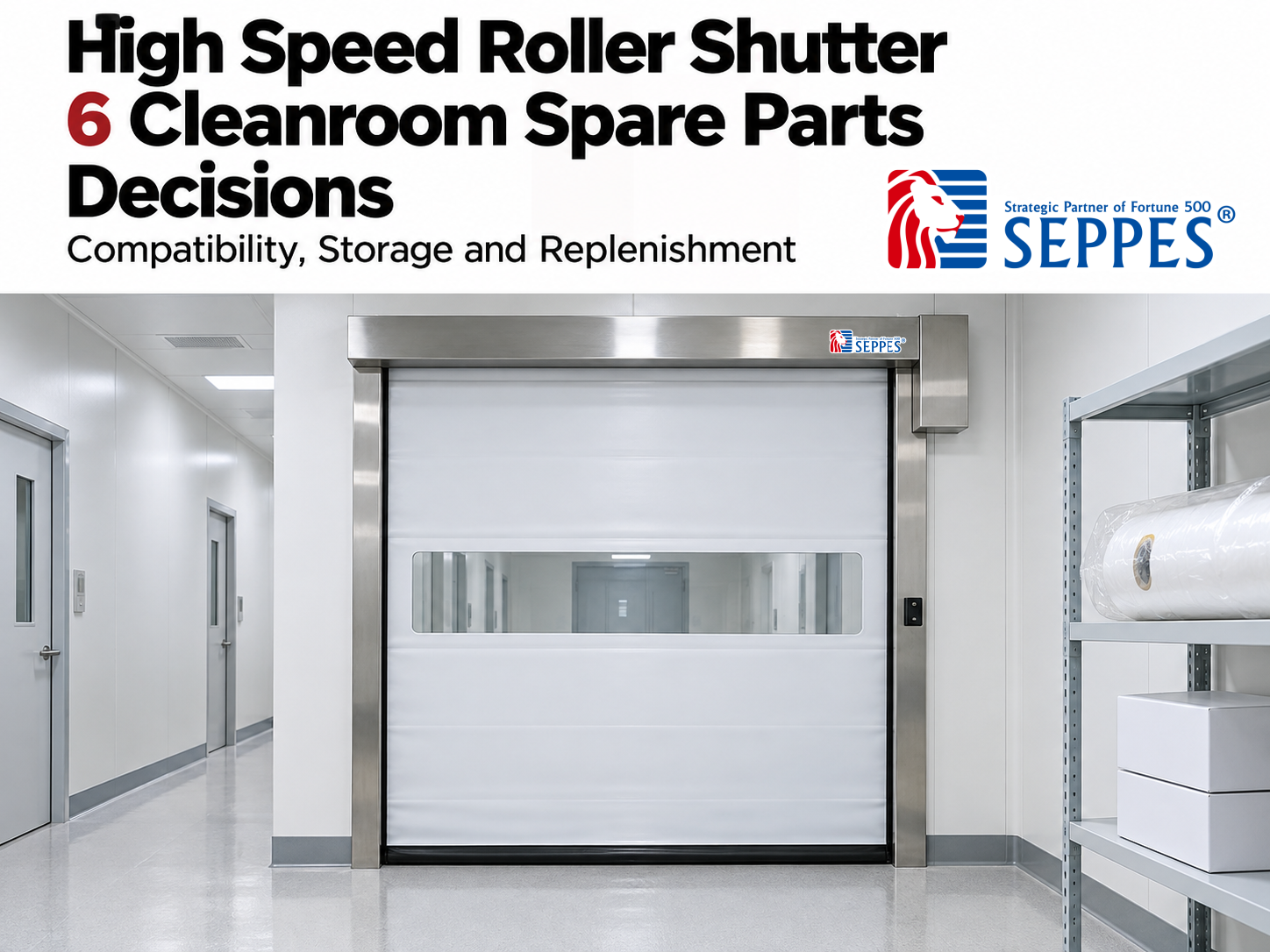

A high speed roller shutter spare parts plan should answer a practical question: if this doorway becomes unavailable, what will the team need to restore its approved function? A shelf of components is useful only when the parts match the installed equipment, remain suitable for use and can be fitted by competent personnel.
Consider a hypothetical cleanroom site with several similar doors. Stores holds a spare curtain and a controller, yet neither has a confirmed link to the affected opening. The stock exists, but the maintenance team still has to resolve compatibility. The following six decisions help turn spare parts purchasing into a usable support plan for a SEPPES cleanroom installation.
1 Build a High Speed Roller Shutter Asset Record
Give each opening a unique asset reference and connect it to the model, serial number, approved drawings and current component list. Include the controller version and documented modifications where relevant. A purchasing description such as white door at the packing room is too easy to misinterpret. For each speed door, record what is actually installed, not just what appeared in the original quotation. A later curtain replacement or approved control change may have altered the correct spare reference. Keep the current record accessible to engineering, stores and the person placing the order.
Ask SEPPES to confirm the applicable references using the available identification and installation records. Where information is missing, arrange an appropriate identification review. Staff should not remove guards or open energized enclosures merely to obtain a better photograph. Keep the evidence with the asset record so the next order does not depend on one employee remembering a past conversation.

2 Stock by Operational Impact
Do not start by buying one of everything. Review which failures could interrupt a controlled transfer route, whether an approved alternative exists and how long the facility can tolerate that interruption. Consider the time needed for identification, supply, installation and site checks, not transport alone.
Use maintenance history and manufacturer recommendations to distinguish planned replacement needs from uncertain future failures. A frequently ordered item may deserve local stock, but repeated consumption can also point to a problem requiring investigation. Increasing stock should not replace a review of recurring damage. The table below is a planning framework, not a universal purchasing list.
| Situation | Decision to review |
|---|---|
| A critical route has no approved alternative | Assess local stock against verified compatibility and supply time |
| Several doors share a confirmed component | Consider a shared spare with explicit asset coverage |
| A costly item has little failure history | Compare local stock with a confirmed sourcing arrangement |
| A part has storage or shelf-life limits | Balance availability against its usable storage period |
Record the reason for each decision and an owner for reviewing it. A stock quantity is a site decision, not a number that can be derived from door count alone.
3 Confirm Interchangeability Before Sharing Stock
Two parts can look alike without being interchangeable. Dimensions, fixing points, curtain edge construction, connectors and control compatibility may all matter. Ask for a documented match to the complete installed assembly before marking a spare as suitable for several openings. A spare advertised for canvas roll up doors should not be assumed suitable for a cleanroom installation. Confirm the specified material, finished dimensions, edge details, vision-panel arrangement and compatibility with the cleaning programme. Similar colour or thickness does not establish equivalence.
SEPPES’s cleanroom-specific catalogue describes zipper-guided curtains, smooth guides, flush vision panels and a flexible safety bottom edge. These features make the relationship between components relevant to the parts discussion. They do not mean every part in the product family can be shared. Create a short compatibility list showing the approved part reference, applicable assets and any restrictions. Keep unconfirmed alternatives outside available stock until their status is resolved.
4 Store Parts in a Condition You Can Verify
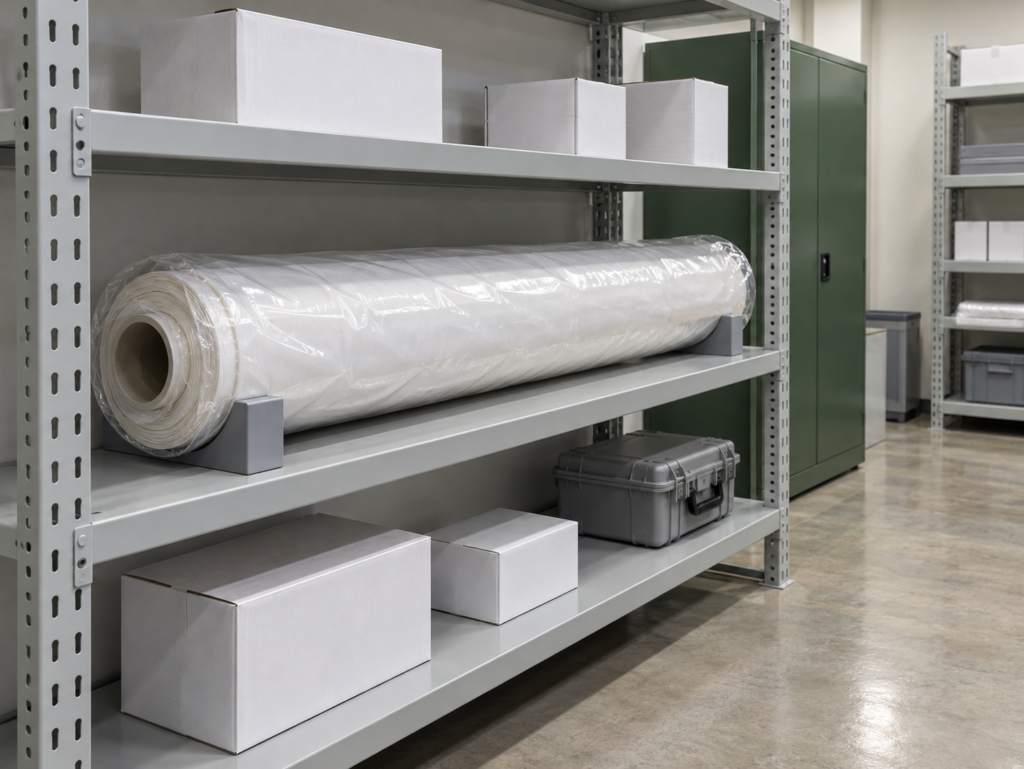
A correct part can become unusable before it reaches the doorway. Obtain the relevant storage and handling instructions, including any packaging, environmental or shelf-life conditions. Do not invent one storage temperature or replacement interval for every component. At receipt, check identification, quantity, packaging condition and the information supplied against the order. Keep the original traceability details with the item. Separate damaged deliveries and unresolved substitutions from stock that has been accepted for use.
Plan storage around the actual component. Ask how a replacement curtain should be supported and packed, and how electrical items should be protected during handling. Use the specified protective packaging rather than leaving parts exposed on a maintenance bench. Inspection and repacking should follow the relevant instructions. Also plan the journey from stores to the cleanroom. Being new or sealed in shipping packaging does not establish that an item is ready to cross a controlled boundary. Define the site’s preparation and transfer requirements before an urgent repair makes the route a last-minute decision.
5 Review Substitutions Before an Urgent Order
An unavailable part often leads to a proposed newer version. Ask what has changed and whether the replacement requires different fittings, configuration, instructions or checks. A supplier’s new part number should trigger a compatibility review, not an automatic update to the stores catalogue. For facilities manufacturing human medicinal products under EU GMP, Annex 15 addresses documented assessment and authorization of planned changes that may affect product quality. Apply the site’s change process to relevant substitutions; do not assume that every spare requires the same qualification work. EU GMP Annex 15, section 11
Outside that regulatory context, engineering still needs a clear approval route for changes to the installed system. Identify who reviews mechanical fit, cleaning compatibility, control interactions and protective functions. Record the accepted replacement and update the asset and stock records together. Keep removed, repaired and new components distinguishable. A returned part should not become an available spare simply because it was placed back in its original box.
6 Keep the SEPPES Parts Plan Current
When contacting a high speed coiling doors supplier, send the asset list, confirmed component references, maintenance history and operating constraints. Ask SEPPES to review the proposed parts list for the installed models and identify unresolved compatibility questions. Confirm availability and delivery terms for the specific order rather than assuming a standard response time. Assign responsibility for recording each issue from stock and arranging replenishment. Review the plan after a configuration change, repeated failure or change in route importance. A shared spare that has already been used elsewhere is no longer protection for the next opening.
Availability also depends on people and documents. Identify the competent personnel, applicable instructions and site checks needed for replacement work. UK HSE maintenance guidance emphasizes planning, competence and the manufacturer’s instructions; stocked parts do not remove those requirements. HSE maintenance guidance
When buying from a high speed coiling doors factory, include support arrangements in the decision. Bring SEPPES a parts plan tied to actual assets and cleanroom procedures. The result should be clear: what is approved, where it is stored, who can use it and how it will be replaced after use.