
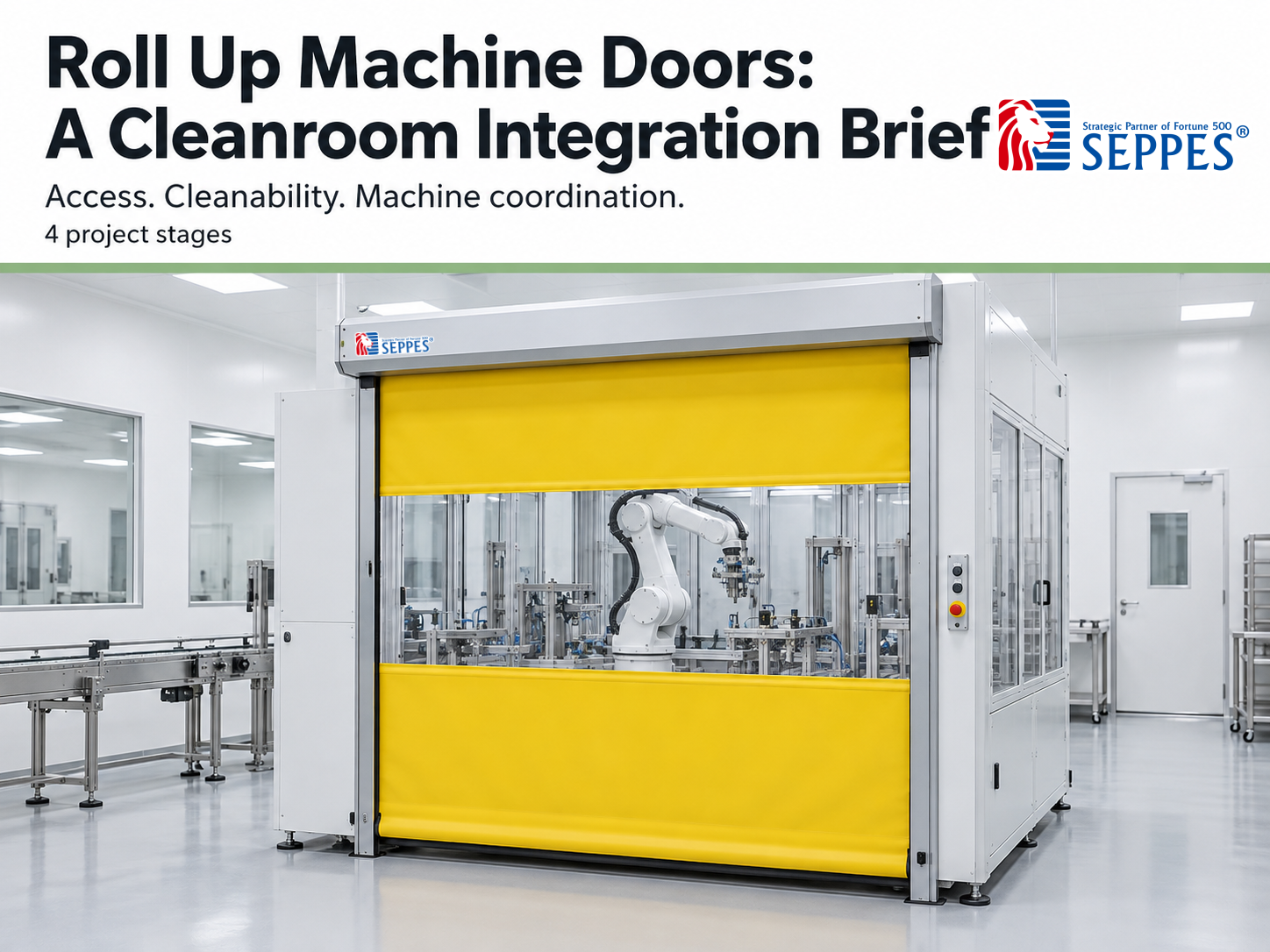

Roll up machine doors bring a different set of questions to a cleanroom project. The opening belongs to a production cell, where components enter, tooling changes and operators need occasional access. The room entrance manages a different boundary. Treating both openings as the same purchase can leave important requirements unresolved. This four-stage brief helps facilities teams, equipment builders and SEPPES define the machine-door package before installation.
1. Specify Roll Up Machine Doors Around the Task
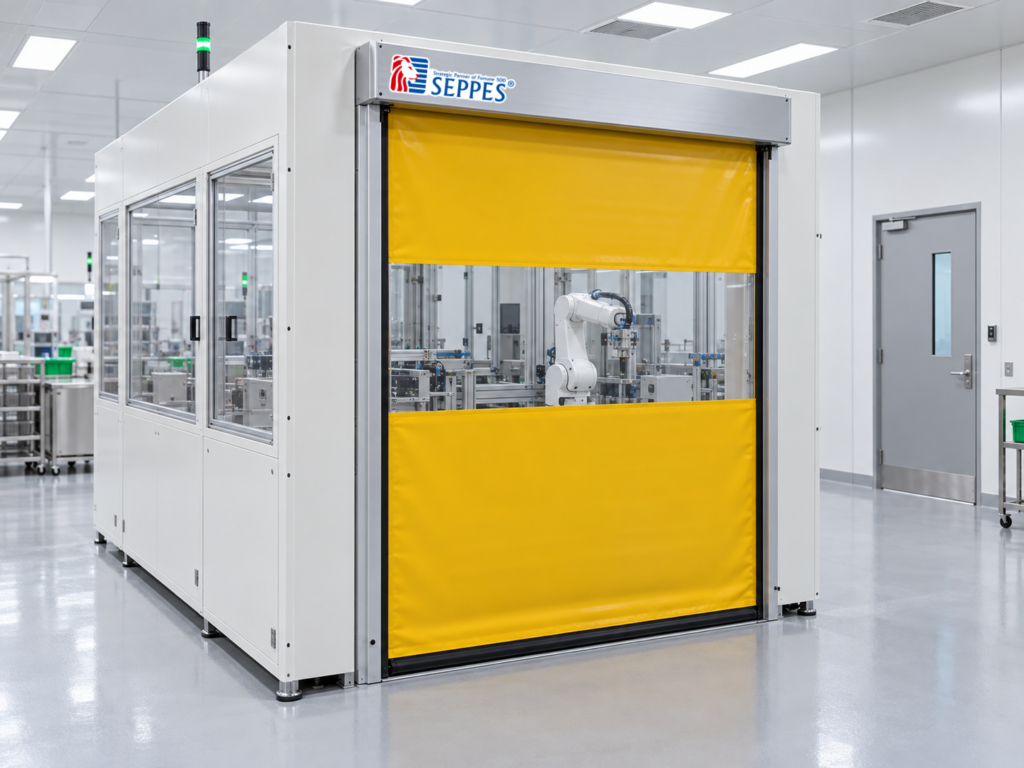
Begin with the machine layout and a description of every access task. Routine loading, tool replacement, cleaning and fault recovery may need different arrangements. Mark the moving equipment, operator positions and the largest item that must pass through the opening. Do not size the door only around the part currently being manufactured.
For manufacturing roll up doors, the surrounding enclosure matters as much as the opening. Check how the frame meets fixed panels, whether service components remain accessible and where material can wait without obstructing an aisle. If the opening also forms part of a controlled-air boundary, bring the cleanroom designer into the review. Otherwise, keep the equipment enclosure and the room separation requirements clearly distinguished.
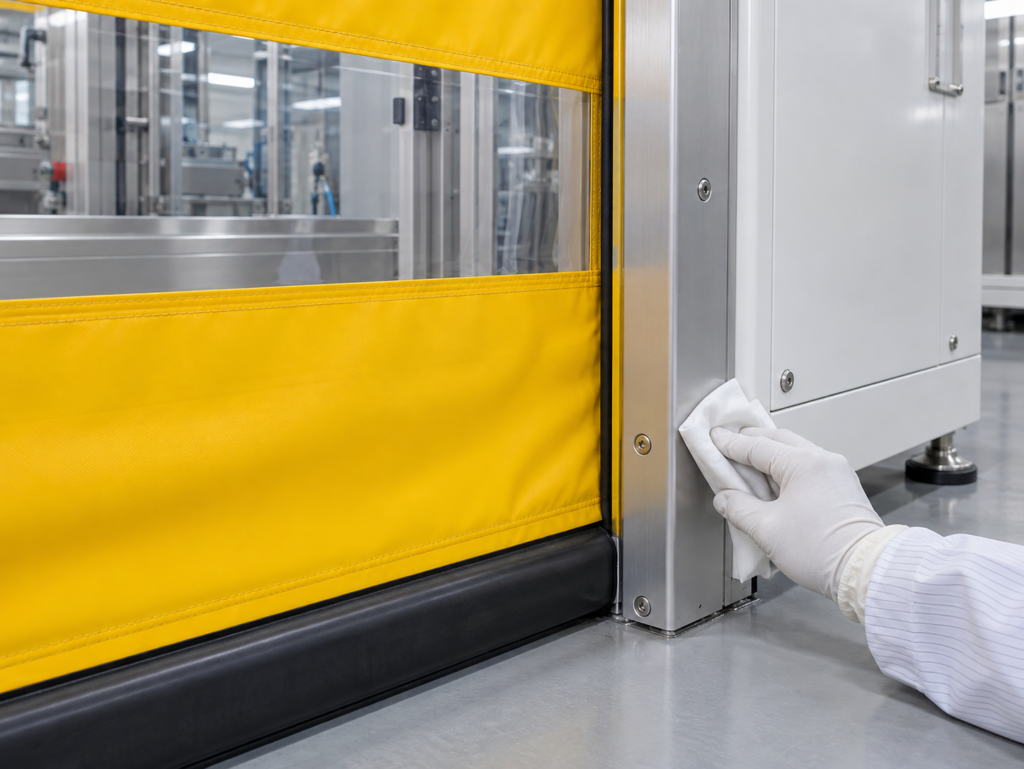
2. Review the Surfaces the Cleaning Team Will Reach
Walk through the proposed cleaning method with the equipment builder. Identify accessible guide surfaces, window edges, bottom seals and connections to the enclosure. Ask for material compatibility with the site’s actual cleaning agents and method, plus instructions for reaching areas that require maintenance access. A smooth exterior is useful, but it does not establish particle performance or suitability for every cleanroom process.
When comparing a flexible curtain with a high speed rigid door, review the complete construction rather than its appearance. If an aluminum high speed door is proposed, clarify whether aluminum describes the frame, the moving panels or both. Discuss joints, surface finish, replacement access and any requirements near exposed product. Put these details in the specification so purchasing is comparing equivalent configurations.
3. Agree on the Signals Before Equipment Is Ordered
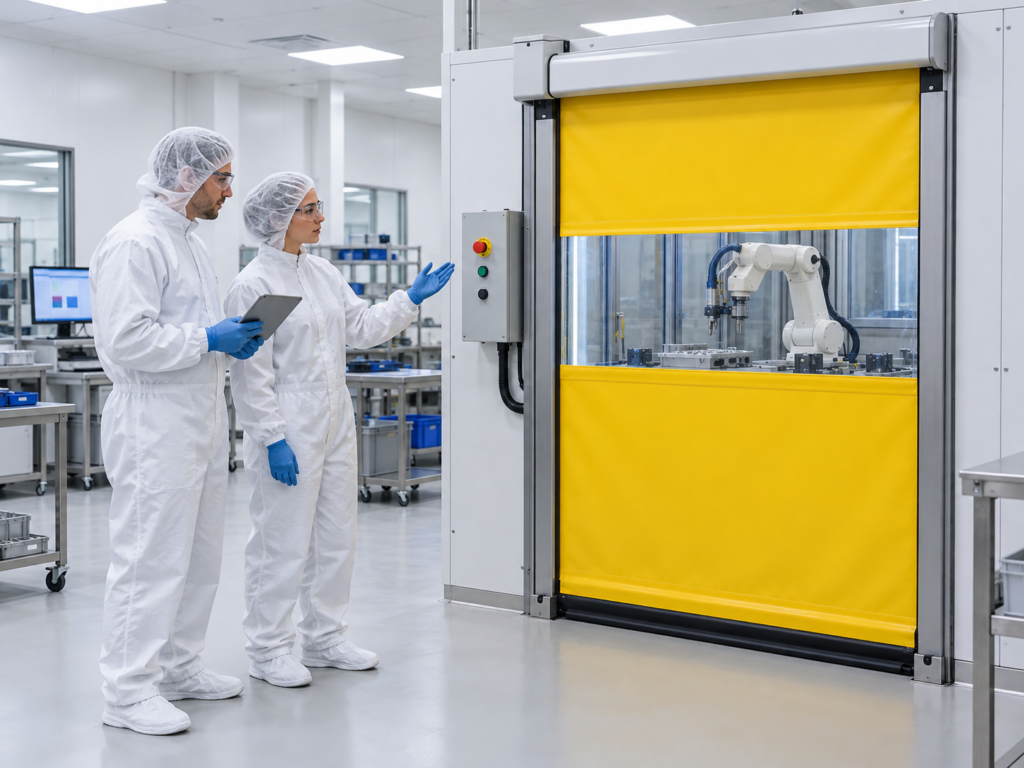
The 2026 SEPPES catalog describes equipment-linkage options for its protective-door range. Its standard protective model also lists an aluminum-profile frame and a display for operating status and fault codes. These features make a concrete starting point for an interface discussion with the machine builder. Confirm the selected model and configuration instead of assuming that every option applies across the range.
Write down which signals are ordinary operating requests and which belong to a safety-related function. An opening command, a door-position indication and permission for hazardous machine movement are different things. HSE guidance explains that machinery may require interlocked guards, sometimes with guard locking, to prevent access to dangerous movement. The competent machinery integrator must determine and validate the required arrangement; a general-purpose door output is not evidence of a validated guarding function. HSE work-equipment guidance.
4. Finish with an Agreed Acceptance Record
Before ordering new high speed doors for a cell, agree what evidence will be reviewed at handover. Include the approved layout, selected materials, interface documentation, cleaning instructions, maintenance access and the integrator’s validation records. Assign an owner to each open issue. A demonstration that the curtain travels up and down is only one part of accepting the installed system.
Keep commissioning and maintenance responsibilities explicit. Follow the machine manufacturer’s isolation procedures before cleaning inside the enclosure, clearing obstructions or making adjustments; a closed door or a stopped production cycle does not replace appropriate isolation. HSE’s machinery-safety guidance discusses these precautions. HSE introduction to machinery safety.
Send SEPPES your equipment drawing, access tasks, cleaning requirements and proposed control-interface brief. Ask for a door configuration that the machine builder and cleanroom team can review together. That gives the project a defined scope for quotation, installation and acceptance, while keeping equipment protection aligned with the surrounding production environment.
