

In the rapidly evolving landscape of smart farming, maintaining a stable internal environment is the cornerstone of high-yield production. For large-scale greenhouse projects, the choice of entry systems is no longer just about security; it is about thermal integrity. This is where Insulated Sectional Overhead Doors for Modern Agriculture have become a critical infrastructure component. Recently, we completed a significant installation for a leading international agricultural technology firm in Northwest China, demonstrating how customized entrance solutions can solve complex climate challenges.
The Challenge: Balancing Scale with Thermal Efficiency
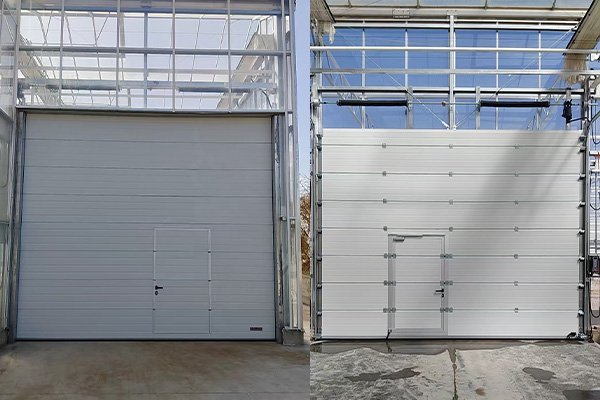
The project site, located in a region characterized by extreme temperature fluctuations and arid conditions, required a door system for a large-scale agricultural greenhouse. The primary challenge was the sheer scale of the opening—approximately 4800mm*3800mm
In such environments, a standard industrial door acts as a massive thermal bridge. Every time the door opens, or even while it remains closed, heat exchange can compromise the delicate microclimate required for specialized crop growth. Our objective was to provide a solution that offered robust structural integrity while maximizing energy efficiency.
Technical Excellence in Insulation
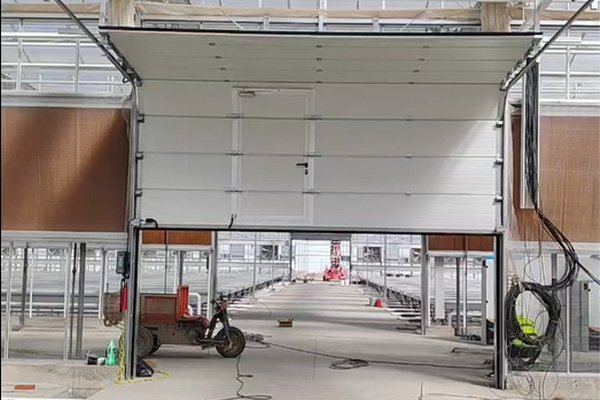
The core of our solution lies in the material science of the door panels. Each panel is constructed using high-density, CFC-free polyurethane (PU) foam sandwiched between hot-dipped galvanized steel skins. This “sandwich” structure is the secret to high thermal resistance.
Thermal Break Technology: The panels are designed to minimize heat conduction. By significantly reducing the U-value (thermal transmittance), these doors ensure that the warmth generated by greenhouse heating systems stays inside during winter, while reflecting external heat during summer peaks.
Comprehensive Sealing: Insulation is only as good as the seals. We utilized heavy-duty EPDM (Ethylene Propylene Diene Monomer) rubber gaskets along the top, bottom, and side tracks. These seals create a multi-layered barrier against drafts, dust, and moisture, ensuring the greenhouse remains a controlled environment.
Integrated Pedestrian Access: A Logic of Efficiency
One of the standout features of this specific project was the integration of a built-in pedestrian door (also known as a wicket door). In a greenhouse facility, personnel movement is frequent, but vehicle access for heavy machinery or large shipments is intermittent.
Opening a 4.8-meter door for one person is inefficient. It causes significant heat loss. This also wears out the industrial motor. It puts unnecessary stress on the torsion springs. We added a small pedestrian door. It is built directly into the main door panel. People can now enter and exit easily. This keeps the building’s heat inside. The thermal seal remains protected.This “door-within-a-door” design features a low-profile threshold and high-quality hydraulic closers to ensure it remains sealed when not in use.
Durability for Arid and High-Humidity Environments
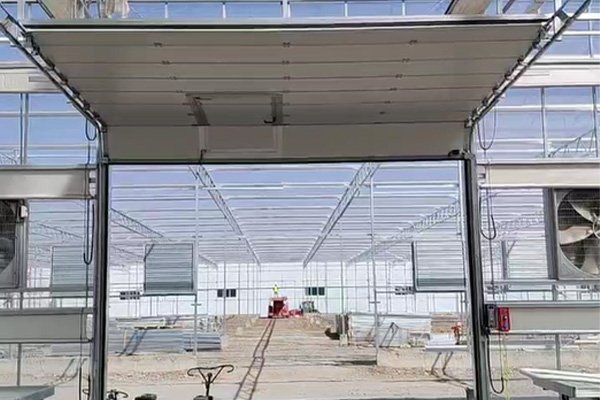
Agricultural greenhouses often present a dual challenge: high internal humidity from irrigation systems and harsh external weather. To counter this, all hardware—including the vertical tracks, hinges, and rollers—is finished with high-quality galvanization to prevent corrosion.
The torsion spring system was calibrated specifically for the 4790*3800 dimensions, ensuring balanced operation even after thousands of cycles. For the client, this translates to lower maintenance costs and zero downtime, which is vital when managing living biological assets that depend on a stable environment.
Conclusion: Why Sectional Doors are the Future of Agri-Tech
As agriculture moves toward a “factory” model, the demand for high-performance industrial doors continues to grow. This project in Northwest China serves as a benchmark for how Insulated Sectional Overhead Doors for Modern Agriculture can be adapted to meet the rigorous demands of global agri-tech leaders.
By prioritizing thermal efficiency, operational convenience through pedestrian access, and long-term durability, we help our clients reduce energy overheads while protecting their crops. For any modern greenhouse facility, the door is no longer just an exit—it is a sophisticated tool for climate management.
