

High speed door cost should be assessed across the period your facility expects to use the opening, not only against the equipment line in a quotation. A cleanroom project can involve installation, planned servicing, replacement parts, electricity and the work needed to return an area to operation after an intervention. These items do not necessarily appear on the same supplier’s invoice.
This guide addresses ownership budgeting after the operating requirements have been defined. It is not a market price list. A cheap high speed door is not automatically a poor purchase, and a higher initial price does not prove lower running costs. The useful comparison is between suitable configurations, using the same period, cost boundaries and evidence.
High Speed Roll Up Doors: Price Is Only the Starting Point
First confirm that each option meets the required opening, traffic, cleaning, control and environmental criteria. A proposal that omits a necessary interface is not an equivalent alternative simply because its total is lower. Keep unresolved requirements visible and ask the supplier to identify the configuration to which its price applies.
A high speed door price may cover supply only or a wider package. Reconcile delivery, unloading, installation, electrical work, integration and agreed acceptance activities before beginning the ownership comparison. Use the existing quotation brief for that scope review; the task here is what happens after the starting figure has been made comparable.
Choose a study period based on the facility’s planning needs. Record the assumed traffic, operating calendar and production route. Five years may be useful for a particular budget discussion, but it is not a universal door life. If one option still has useful value at the end, account for that consistently rather than assuming every asset becomes worthless.
Build a High Speed Door Cost Budget in Seven Categories
The US Department of Energy’s acquisition guidance explains why equipment buyers should consider installation, energy, maintenance, repair, replacement and disposal alongside purchase cost. Its federal procurement rules are not being presented here as requirements for every cleanroom buyer; the useful principle is to define the full cost boundary. DOE life-cycle cost guidance.
For a door project, the following working categories help purchasing, engineering and operations assign inputs to the people who can support them. Some items are supplier charges; others are internal site costs. Label an unavailable amount as pending instead of hiding it in a general allowance with no explanation.
| Cost Category | Evidence to Request or Develop |
|---|---|
| 1. Equipment and delivery | Confirmed configuration, packing, freight and applicable landed charges |
| 2. Installation and acceptance | Site work, connections, integration, attendance and agreed checks |
| 3. Planned upkeep | Cleaning and inspection tasks, service scope, labour and consumables |
| 4. Repairs and replacements | Relevant parts, labour, availability and the basis for any repair allowance |
| 5. Energy | Door electricity and any separately supported HVAC effect |
| 6. Operational interruption | Incremental disruption, alternative routing and return-to-service work |
| 7. End-of-period value or cost | Remaining value, removal, disposal or reinstatement assumptions |
Avoid counting the same expense twice. A service contract may already include a scheduled visit, and an installed quotation may already include commissioning. Similarly, lost production, paid labour and overtime can overlap. Have the relevant budget owner explain what each line includes before adding it to the total.
Turn Product Details Into Supported Budget Inputs
The SEPPES 2026 catalog describes an interface that displays operating status and fault codes on its rapid-door range. That is useful information to discuss when planning fault reporting and service support. It does not establish a repair duration, local labour rate or guaranteed reduction in downtime. Ask what documentation and diagnostic support apply to the selected model.
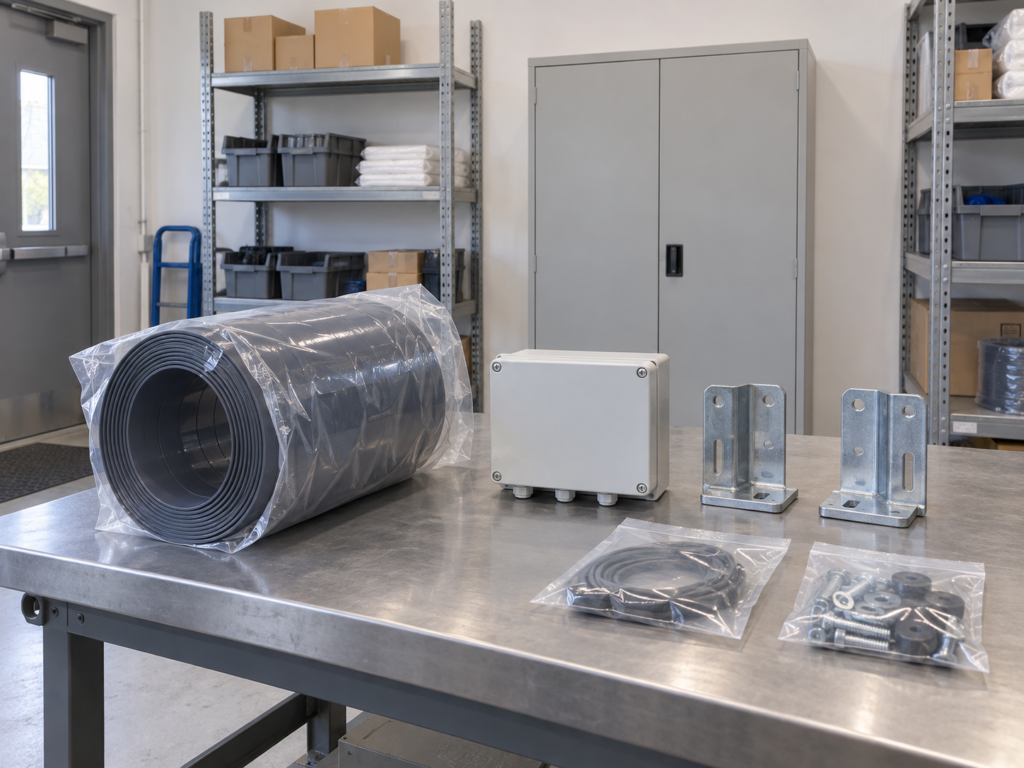
Request a proposed service scope, the basis for inspection intervals and information on relevant replacement components. Confirm what can be stocked locally, what needs identification by model or serial number, and which work needs specialist attendance. Do not turn a component cycle claim into a calendar replacement date without considering the operating conditions and the manufacturer’s guidance.
Energy also needs a defined boundary. A motor’s rated power multiplied by every hour the facility is open is not a measured annual consumption figure. Use a suitable measurement or a documented model that includes the actual operating pattern and relevant standby loads. Any heating or cooling effect should be evaluated separately against comparable traffic and room conditions, not added as a guaranteed percentage saving.
In the high speed door market, product labels alone cannot provide these site-specific inputs. Record whether each number is quoted, measured, estimated or still unknown. That distinction is often more useful than a total carried to the nearest cent.
A Five-Year Example: Lower Running Costs Do Not Always Win
The figures below are invented monetary units for arithmetic only. They are not SEPPES prices, market benchmarks or performance predictions. Assume both options meet the same requirements and use the same route. For this example only, both are removed after five years at a net cost of 500 units; this is a project assumption, not a service-life claim.
The comparison uses constant annual allowances and does not discount future costs. Energy here means assumed door electricity only. HVAC effects, operational interruption, tax, finance, price escalation and complete door replacement within the period are excluded. Those exclusions must not be read as zero real-world costs.
| Illustrative Input | Option A | Option B |
|---|---|---|
| Installed starting cost | 10,000 | 11,500 |
| Annual door electricity | 700 | 650 |
| Annual planned upkeep | 500 | 400 |
| Annual repair allowance | 300 | 200 |
| Total recurring allowance per year | 1,500 | 1,250 |
| Net removal cost at year five | 500 | 500 |
| Five-year subtotal | 18,000 | 18,250 |
Option A totals 10,000 + (5 × 1,500) + 500 = 18,000. Option B totals 11,500 + (5 × 1,250) + 500 = 18,250. B’s assumed annual advantage of 250 saves 1,250 over five years, which does not recover its 1,500 higher starting cost. Under these limited assumptions, B remains 250 more expensive.
This is a screening subtotal, not a complete discounted life-cycle analysis. NIST Handbook 135, 2025 edition, explains present-value methods and the treatment of costs across time. For an approval model, ask the finance owner to apply the project’s study period, discounting convention and remaining-value assumptions consistently. NIST life-cycle costing manual.
Test the Assumptions That Could Change the Decision
Keep A unchanged and vary only B’s assumed annual advantage. If that advantage is 150 units, B’s five-year subtotal becomes 18,750. If it is 400, the subtotal becomes 17,500. The preference changes because an uncertain input changed, not because the initial quotations changed. Investigate the evidence behind that input before claiming a winning option.
Treat disruption with the same care. Establish whether a stopped doorway actually stops production, causes a detour or can be managed during planned downtime. Record incremental costs and the time needed for any required cleaning or release checks. Do not assume the whole site’s hourly sales value is lost whenever one door is unavailable.
Consider parts availability and warranty scope alongside the numbers. Ask about relevant parts, lead-time assumptions, exclusions and responsibility for travel or labour. A spare on the shelf has an upfront holding cost, while an unstocked item can create uncertainty. Neither arrangement is automatically better; assess it against the route’s operational importance.
Build the SEPPES Review Around Evidence, Not a Target Saving
Send SEPPES the agreed door requirements together with the study period, operating calendar, expected traffic and cleaning conditions. Ask for the offered configuration, included service scope, relevant parts information and the support available for the project location. Keep owner estimates separate from supplier commitments.
Have purchasing reconcile the initial scope, engineering check technical suitability, operations review maintenance and route interruption, and finance review the cost model. Any important missing input should remain an open action with a responsible person, not disappear behind a confident-looking total.
For a cleanroom door solution, the goal is a suitable configuration and a budget your team can explain. Revisit the assumptions after commissioning and use actual service, consumption and interruption records to improve the next decision. A credible ownership plan does not promise that the cheapest or most expensive door will win; it shows why the selected arrangement fits the project.
