
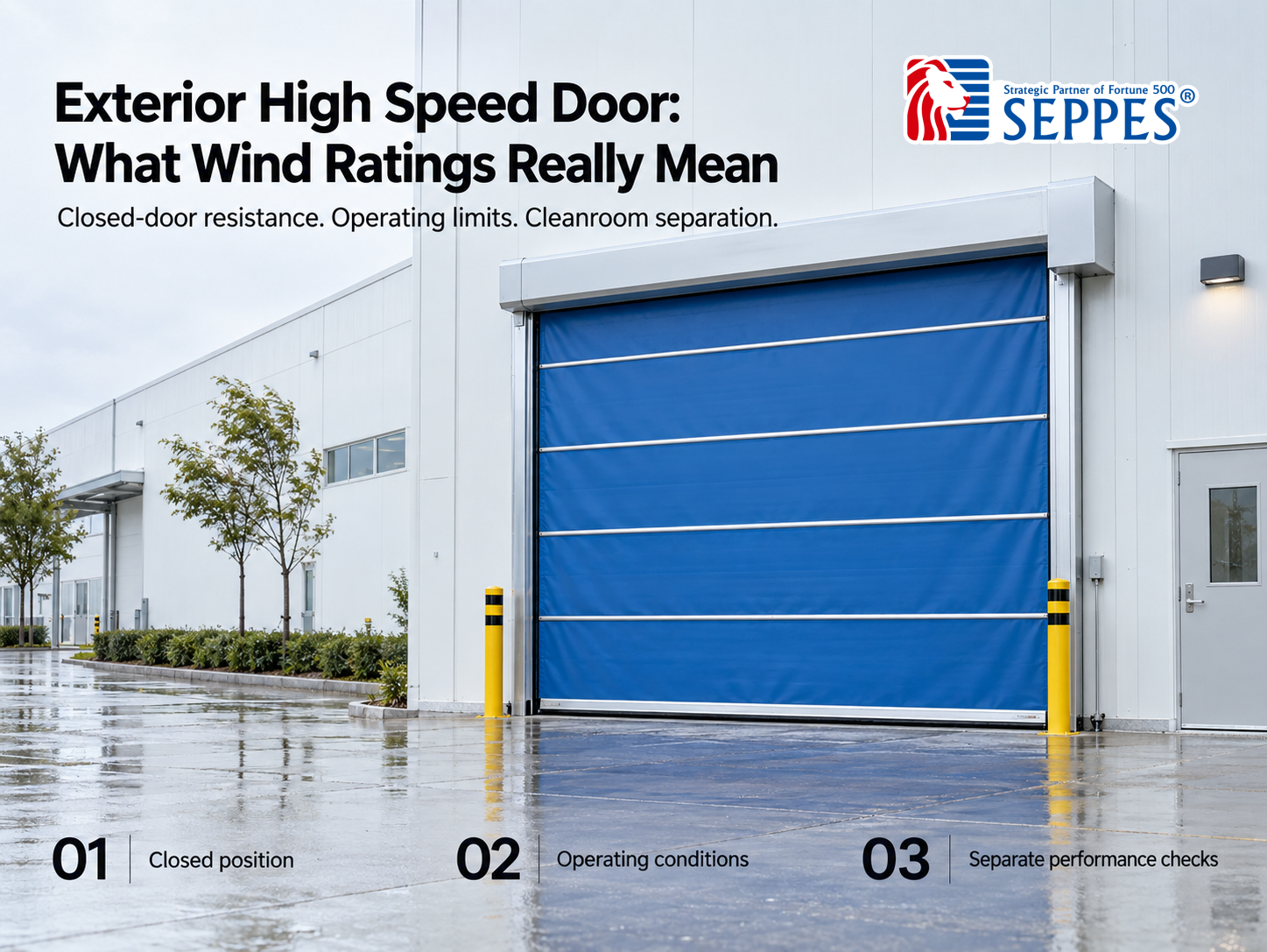

An exterior high speed door can look reassuring on a specification sheet: reinforced construction, fast travel and a prominent wind-resistance claim. For a factory with clean production areas, however, that headline leaves important questions unanswered. Does the rating cover a closed door or a moving one? Does it apply to your opening size? And what does it actually say about the cleaner spaces farther inside?
SEPPES recommends separating these questions before comparing products. A weather-facing entrance and a controlled room boundary have different jobs, even when both need frequent access.
Does an Exterior High Speed Door Rating Cover Movement?
Not by itself. EN 12424 classifies resistance to wind load with the door in the closed position, as stated in the official EVS standard summary. The practical implication is straightforward: a closed-position classification should not be read as permission to open or close the door in equally demanding conditions.
Ask for the manufacturer’s operating limits separately. The useful answer identifies the relevant door configuration, any restrictions during adverse weather, and the approved response when those limits are reached. A label such as heavy-duty exterior high speed door does not replace that information.
For the site team, this distinction affects continuity of access. Discuss the operating procedure before installation, including who may suspend traffic and how alternative access will be managed. Do not improvise a wind test with vehicles or personnel in the doorway.
Does the Rating Apply to This Opening?
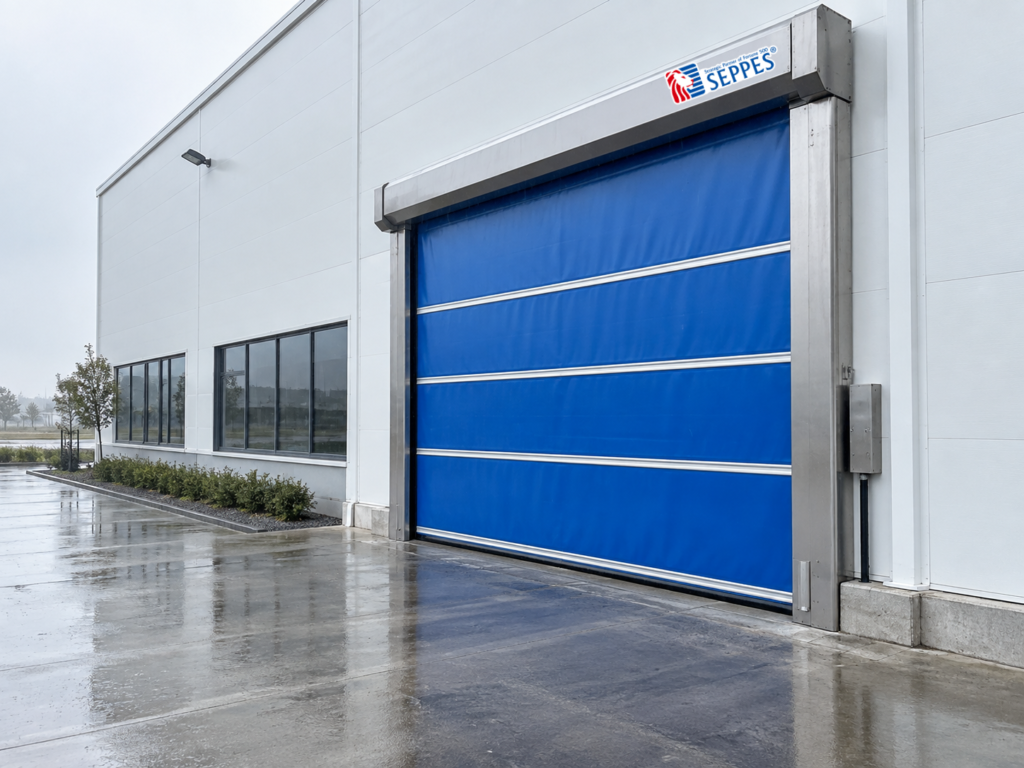
A product-family headline is only a starting point. Request evidence that covers the proposed width, height, curtain or panel construction, reinforcement and guide arrangement. Also confirm the supporting structure and installation requirements with the responsible project engineer. A high speed overhead door selected for a sheltered elevation should not automatically become the specification for an exposed entrance elsewhere on the building.
The same scrutiny applies when comparing rigid high speed exterior doors with flexible constructions. Metal panels alone do not establish a particular rating. Ask what has been tested or assessed, which sizes are covered, and whether the quoted assembly matches that scope.
If daylight or visibility matters, check the exact glazed configuration too. For a high speed exterior full-view door, request confirmation that the stated performance includes the proposed transparent sections and their framing. Keep this evidence with the approved drawings so later substitutions do not quietly change the basis of selection.

Does Wind Resistance Prove Cleanroom Suitability?
No. Resistance to wind load, air permeability and resistance to water penetration are separate performance characteristics. For example, EN 12426 addresses air-permeability classification, rather than wind resistance. A strong result in one category is not evidence of an equivalent result in another.
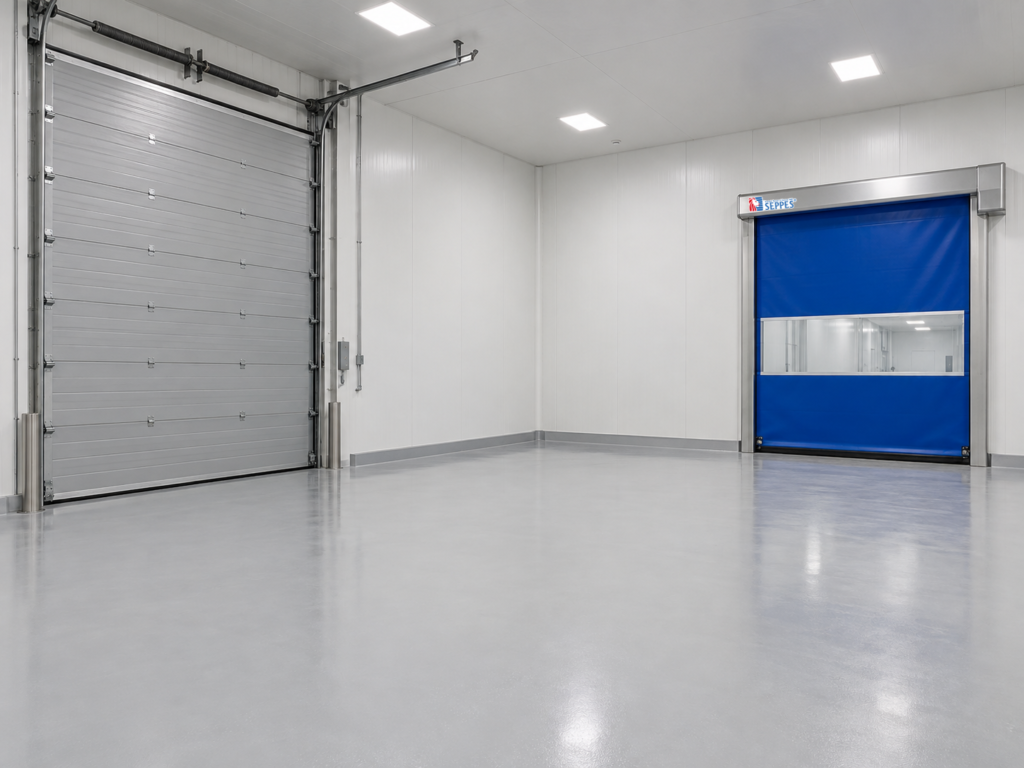
At a controlled-production facility, the outer entrance may face rain and outdoor contamination, while the inner doorway forms part of the room’s environmental-control strategy. Specify each boundary against its actual role. Do not treat the exterior door’s rating as validation of room cleanliness or pressure control.
Likewise, a fast opening cycle does not remove the need to assess the route between those boundaries. The project may need a receiving space, a material-transfer procedure or a separately controlled inner entrance. Those decisions belong to the facility design and process team, not to a wind-class label.
What Should SEPPES Confirm for Your Project?
The SEPPES 2026 catalog describes a wind-reinforced stacking design with horizontal reinforcing members and an external aluminum-profile option. It also presents a separate cleanroom-specific design with zipper-engaged guides, a tensioning arrangement and flush vision windows. These are useful construction details for two different applications, not interchangeable performance certificates.
Start the discussion with an exterior photograph, the opening dimensions, the building location and exposure, and a drawing showing the adjacent production spaces. Include the project’s required wind criteria and the conditions in which access must remain available. Ask SEPPES to identify the proposed model, applicable evidence, installation requirements and operating restrictions in its technical submission.
For the inner boundary, review the cleanroom door solution separately with the environmental-control team. Contact SEPPES with both sets of requirements to develop a coordinated proposal. The result should make clear what each door is expected to do, and which evidence supports that expectation.
