
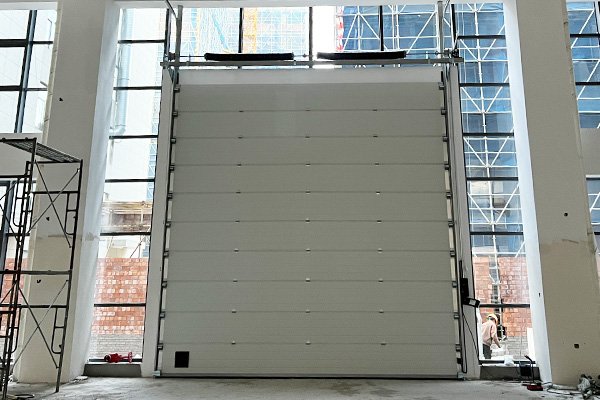

Whether you are managing a busy industrial warehouse or a residential garage, the importance of reliable sectional door safety components cannot be overstated. A sectional door is often the largest moving object in a building, operating under significant tension and gravity. Without the right safety mechanisms, a mechanical failure could lead to catastrophic property damage or, worse, serious injury.
In this guide, we’ll break down the four pillars of sectional door safety: torsion spring anti-break devices, cable break protection, safety edges (airbags), and end buffers.
Torsion Spring Anti-Break Device (Spring Brake)
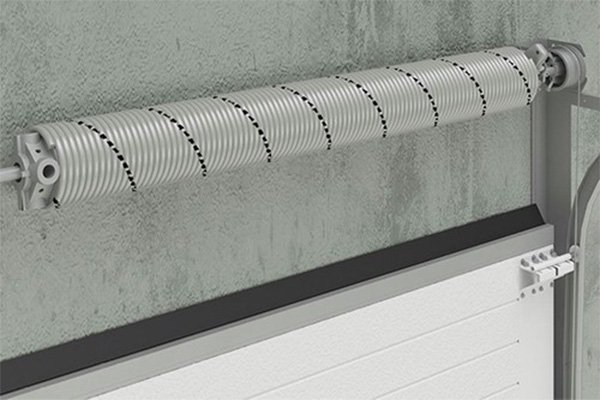
The torsion spring is the “muscle” of your door, neutralizing its weight so it can be lifted easily. However, these springs have a finite lifespan (measured in cycles). When a spring inevitably snaps due to fatigue, the door can come crashing down.
How it works: An anti-break device is installed directly on the shaft. If the spring breaks, the mechanism instantly engages a pawl into a ratchet wheel, locking the shaft in place and preventing the door from falling.
Why it’s essential: It turns a potentially lethal accident into a simple maintenance task.
Cable Break Protection (Safety Bottom Brackets)
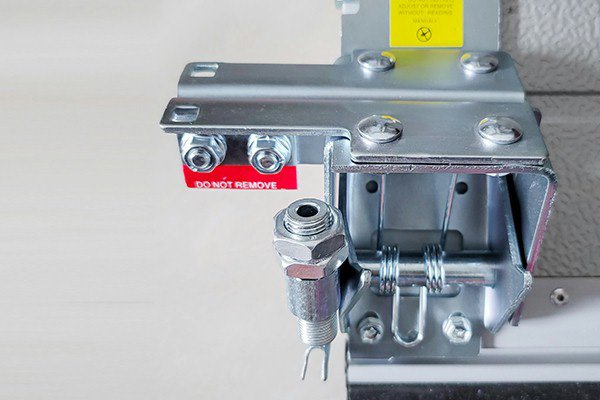
While the springs provide the lift, the steel cables transfer that force to the door panels. If a cable frays or snaps, the door will become unbalanced and drop rapidly on one side.
The Mechanism: Safety bottom brackets are equipped with a spring-loaded “knife” or wedge. Under normal tension, the blade is held back. If the cable loses tension (breaks), the blade fires outward and digs into the vertical track, wedging the door firmly in position.
Maintenance Tip: Always look for signs of “bird-caging” (fraying) on your cables during monthly inspections.
Safety Edge Systems (The “Airbag” Sensor)
Mechanical stops protect against component failure, but the Safety Edge—often referred to as a safety airbag system—protects people and vehicles from the door’s downward movement.
Pneumatic (Airbag) vs. Optical: * Pneumatic: Uses a rubber seal at the bottom of the door. When it hits an object, the air is compressed, triggering a pressure switch that tells the motor to reverse.
Optical: Uses an infrared beam inside the bottom seal. If the seal is deformed, the beam is broken, and the door stops immediately.
The Benefit: This is your primary defense against “crush” accidents, ensuring the door backs off the moment it touches an obstruction.
End Buffer Devices (Track Stops)
Sometimes the simplest sectional door safety components are the most effective. End buffers are heavy-duty springs or rubber bungs installed at the very end of the horizontal tracks.
Function: They prevent the door rollers from running off the tracks if the motor limit switches fail or if the door is opened manually with too much force.
Damping Effect: High-quality spring buffers provide a “soft stop,” reducing the mechanical shock to the tracks and rollers, which extends the overall life of the door hardware.
Summary of Essential Safety Components
| Component | Primary Risk Mitigated | How it Activates |
| Spring Anti-Break | Total door fall due to spring fatigue | Mechanical pawl locks the shaft |
| Cable Break Device | Sudden drop due to snapped lifting cables | Blade/wedge locks into the side track |
| Safety Edge | Crushing people, pets, or vehicles | Pressure/Optical sensor reverses motor |
| End Buffers | Door derailing or over-travel | Physical spring-loaded stop at track end |
Conclusion: Safety is Not an Option
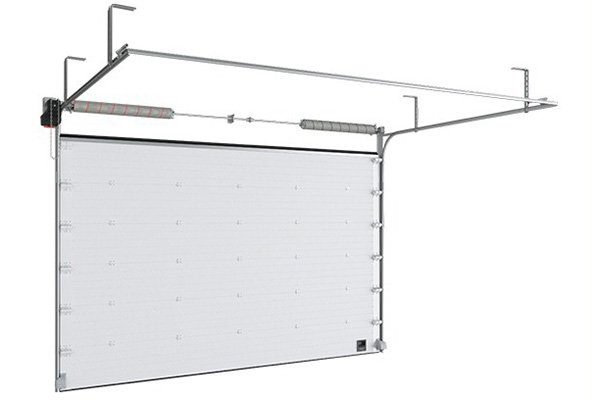
Investing in high-quality sectional door safety components isn’t just about following building codes (like EN 13241-1); it’s about peace of mind. A door equipped with these four safeguards ensures that even if a part fails, the system fails safely.
Are you unsure if your current door meets modern safety standards?
Contact SEPPES now for your personalized quote.
