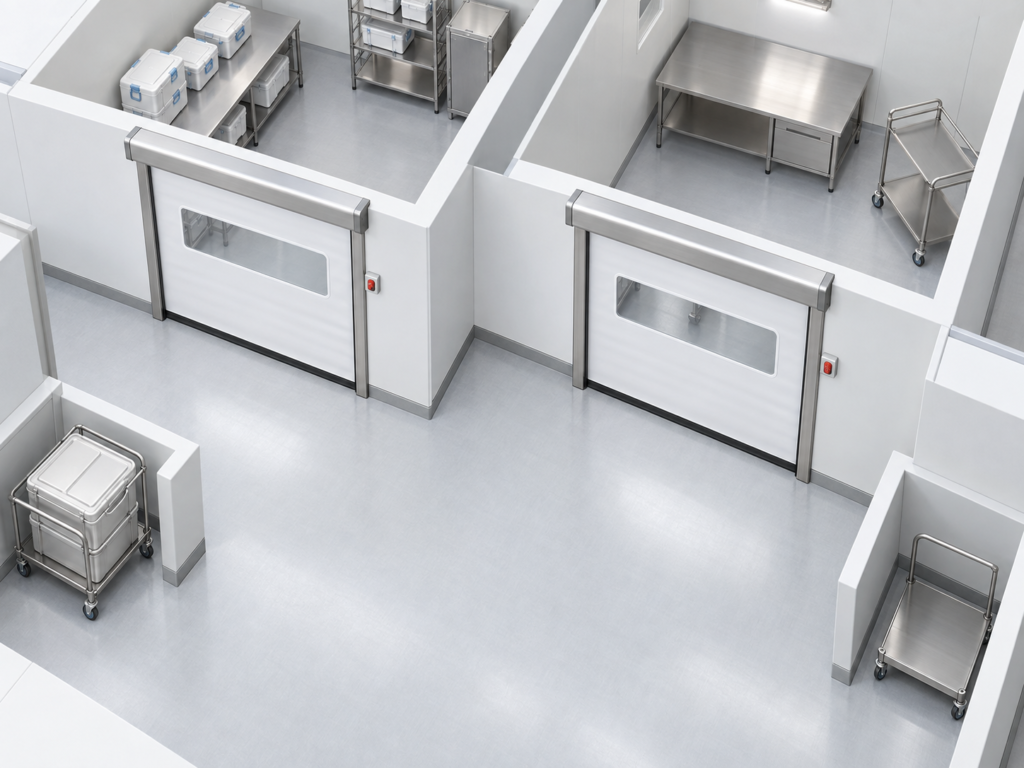

A laboratory high-speed door should fit the work happening on both sides of the opening. In a clean support corridor, that may mean moving covered sample carts or clean supplies without repeatedly handling a door. At a laboratory boundary, however, access restrictions and the facility’s risk assessment come first. These five questions help laboratory planners decide where a SEPPES rapid door belongs and what the proposed configuration needs to address.
1. Where Does a Laboratory High-Speed Door Fit?
Consider an indoor connection between a clean support area and a controlled corridor where carts pass regularly. First identify whether the doorway is a convenience barrier, a controlled-access boundary or part of a containment system. These functions are not interchangeable. A fast curtain does not, by itself, establish a biosafety level or provide a qualified containment barrier.
The CDC/NIH BMBL places risk assessment at the center of laboratory biosafety planning. Have the responsible laboratory team confirm the door’s role before choosing its operating features. This article concerns clean support routes, not a specification for high-containment laboratories. CDC/NIH BMBL guidance.
2. Can Staff Move a Loaded Cart Without Awkward Stops?
Start with the cart and its operator, not just the opening width. Include handles, projecting trays, the person’s working position and any turn immediately before the doorway. When evaluating high speed traffic doors, check whether the approach allows a straight passage and whether someone coming from the opposite direction can be seen.
The SEPPES cleanroom-specific catalog describes a flush vision window and optional contactless activation. Discuss window placement against the actual load height and distinguish an opening request from permission to enter. Where authorization is required, a motion trigger must not become an unrestricted access route. Confirm how the selected protective devices detect the person and cart throughout passage, including a pause or change of direction.
3. Which Details Matter During Routine Cleaning?
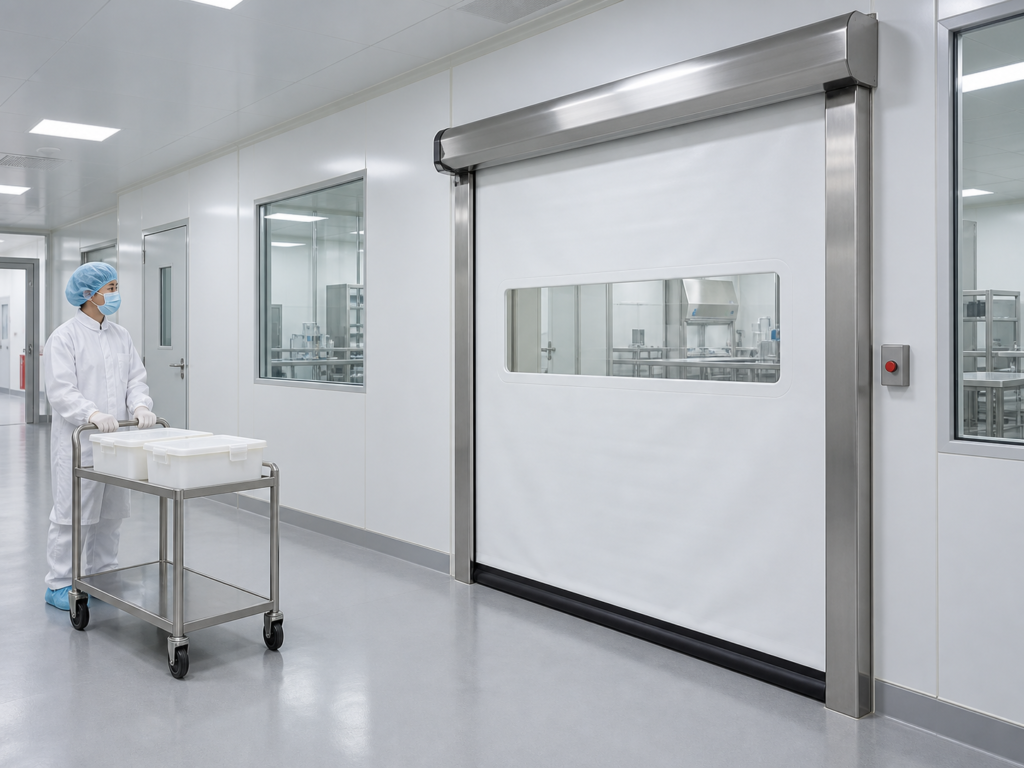
A high speed door curtain is only one of the surfaces included in the cleaning plan. Review the window edges, guides, bottom edge, frame and nearby controls as a complete opening. Ask which areas staff can reach safely using the approved procedure, without reaching into a moving mechanism.
The catalog’s flush window and smooth guide arrangement provide specific details to review with SEPPES. Request material compatibility information for the site’s cleaning agents, concentrations and contact times; do not assume that every transparent panel or flexible seal tolerates the same treatment. If the routine includes spraying or frequent wet cleaning, confirm the suitability of the entire proposed assembly, including controls and electrical components.
4. What Happens After an Impact or a Door Fault?
A flexible bottom high speed door can be a configuration to discuss where carts pass close to the curtain. SEPPES describes a flexible safety bottom edge on its cleanroom model, but that feature does not authorize contact or replace correctly selected protective devices and operating procedures.
Agree on the response to a damaged edge, displaced curtain or repeated fault before the route goes into service. Remove an unsafe door from use under the site’s procedure and have qualified personnel assess it. For high speed door repairs, record the model, visible condition and reported fault without entering the movement zone. Define an approved alternative route so staff are not tempted to hold the opening clear or bypass a safeguard.
5. How Should the Door Work with the Laboratory Layout?
Draw both the loaded journey and the return journey. A route that works for incoming supplies may become congested when empty carts, personnel and outgoing materials use it together. Identify waiting positions outside the movement and detection zones, and keep any required separation between clean supplies and returning materials.
Where adjacent doors need coordination, the SEPPES catalog lists interlock functions for project discussion. Have the laboratory and controls teams define the permitted sequence, fault response and emergency arrangements for the actual facility. Confirm the proposed configuration rather than assuming every function is standard.
Review the SEPPES laboratory application solution with a simple route sketch, cart dimensions and cleaning requirements. Ask the team to identify suitable openings and any conditions that need further assessment. The aim is a door arrangement that supports the laboratory’s approved workflow, with its limits understood before installation.