
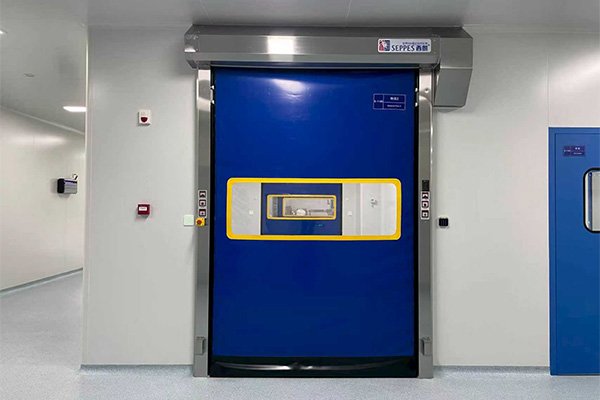

In pharmaceutical, electronics, biotechnology, medical device, food packaging, and precision manufacturing facilities, cleanroom high speed doors are more than simple access equipment. They are part of the contamination control system. Every door opening can disturb airflow, reduce pressure stability, introduce airborne particles, and increase the workload of HVAC filtration systems. For cleanrooms that must maintain ISO-classified air cleanliness, fast, sealed, and easy-to-clean doors help protect both production quality and environmental stability.
Cleanroom design is usually evaluated by particle concentration, airflow direction, pressure differential, temperature, humidity, and cleaning performance. According to ISO 14644-1, ISO Class 5 allows a maximum of 3,520 particles/m³ at ≥0.5 μm, while ISO Class 7 allows 352,000 particles/m³ and ISO Class 8 allows 3,520,000 particles/m³ at the same particle size. This means that moving from ISO 8 to ISO 7 requires a tenfold reduction in allowable particles, and moving from ISO 7 to ISO 5 requires a further hundredfold reduction. In this environment, door performance directly affects how easily the room can maintain its target cleanliness class.
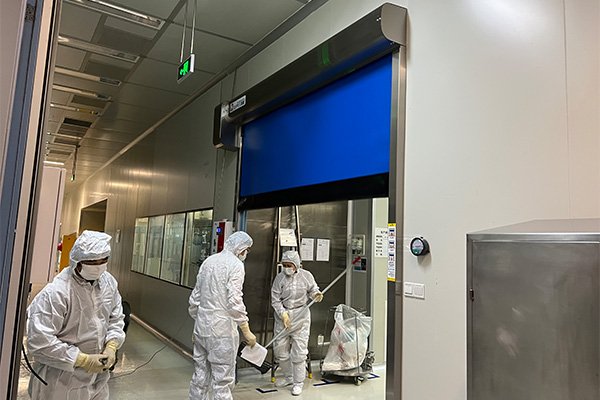
Why Door Openings Are a Critical Risk Point
Cleanrooms depend on controlled airflow. When a conventional slow door remains open for too long, external air can enter the controlled zone, pressure balance may fluctuate, and particles can be carried inside by personnel, carts, equipment, or air turbulence. In high-frequency access areas, this problem becomes more serious because the total opening time accumulates throughout the day.
For example, if a 3-meter-high opening is equipped with a door running at 0.25 m/s, the opening process may take around 12 seconds. A high speed door operating at 1.2 m/s can complete the same opening in about 2.5 seconds. That difference saves approximately 9.5 seconds per cycle. If the door cycles 200 times per day, the cleanroom may avoid more than 30 minutes of unnecessary exposure time daily. This is why cleanroom high speed doors are especially valuable for material transfer rooms, packaging areas, airlock zones, and production corridors.
Supporting Pressure Differential and Airflow Stability
Pressure differential is one of the key engineering controls used to prevent contamination migration. EU GMP Annex 1 states that adjacent rooms of different grades should have an air pressure difference of at least 10 Pascals as a guidance value. It also emphasizes that pass-through hatches and airlock doors should not be opened simultaneously, and that interlocking systems should be used for airlocks leading to Grade A and Grade B areas.
This requirement explains why door selection cannot be separated from cleanroom HVAC design. A door with poor sealing, slow opening speed, or unstable operation can make pressure cascades harder to maintain. By contrast, a properly specified cleanroom high speed door helps reduce the duration of pressure disturbance and limits uncontrolled air exchange between rooms of different cleanliness grades.
WHO GMP guidance also notes that airflow direction and pressure differentials should be appropriate to the product, process, operator protection, and environment. It further recommends pressure differential indication through gauges or electronic monitoring systems, with defined operating ranges, alert limits, and action limits.
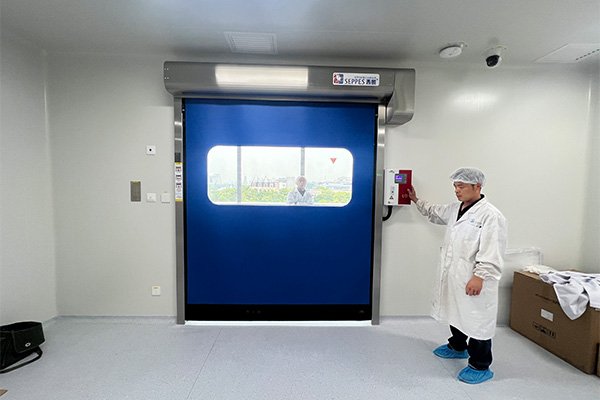
Key Design Features of Cleanroom High Speed Doors
A professional cleanroom door should not only open quickly. It should also support cleanability, sealing, durability, and safety. Important design points include:
1. High opening and closing speed
Fast operation reduces the time that the cleanroom is exposed to adjacent areas. This helps lower the risk of particle ingress and supports pressure recovery after each cycle.
2. Full-perimeter sealing
Side guides, bottom sealing, and top sealing should be designed to reduce air leakage. For higher requirements, zipper-type self-repairing structures or tight guide systems can improve sealing continuity.
3. Smooth and cleanable surface
Door curtains, frames, covers, and control components should avoid unnecessary grooves, exposed dust-trapping structures, and hard-to-clean corners. FDA aseptic processing guidance highlights the importance of smooth, hard, easily cleanable surfaces, temperature and humidity control, HEPA-filtered positive-pressure air, environmental monitoring, cleaning and disinfecting systems, and maintenance systems for aseptic environments.
4. Safe operation for personnel and material flow
Cleanrooms often have frequent personnel movement, trolleys, AGVs, forklifts, or packaged goods transfer. Safety devices such as photoelectric sensors, safety bottom edges, and light curtains help prevent impact during high-frequency operation.
5. Compatible access control
Radar sensors, pull cords, push buttons, remote controls, card readers, face recognition, and interlocking control can be selected according to the cleanroom workflow. For airlocks, interlock logic is particularly important to prevent both doors from opening at the same time.
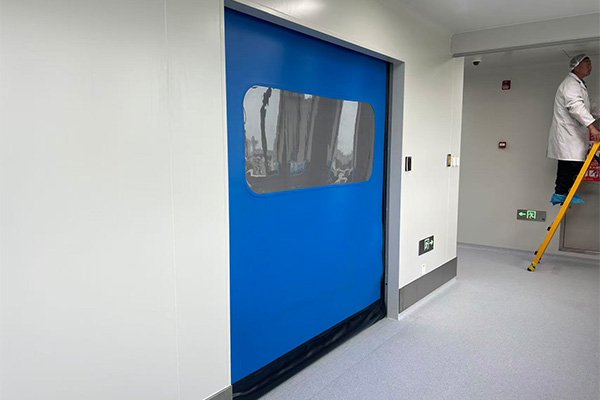
Application Areas
Cleanroom high speed doors are widely used in controlled production environments where both cleanliness and efficiency are required. Typical applications include pharmaceutical workshops, medical device production rooms, biotechnology laboratories, electronics assembly areas, lithium battery production zones, food packaging rooms, cosmetics workshops, and precision instrument manufacturing facilities.
In pharmaceutical and biotechnology environments, the priority is contamination prevention and pressure control. In electronics and precision manufacturing, airborne particles can affect product performance, yield rate, and process reliability. In food and cosmetics production, fast-sealing doors help reduce dust, insects, moisture, and uncontrolled airflow between production and non-production zones.
How to Specify the Right Door
The specification of cleanroom high speed doors should be based on the cleanroom class, opening size, traffic frequency, pressure differential, temperature and humidity range, cleaning method, access control requirements, and safety standard. For example, an ISO Class 8 packaging room with moderate traffic may require a different configuration from an ISO Class 7 pharmaceutical transfer corridor or an airlock connected to a higher-grade area.
Before selecting the door, project engineers should confirm:
Opening width and height
Required cleanroom grade
Daily opening frequency
Room pressure differential
Material transfer method
Required opening speed
Frame material requirements
Door curtain material and transparency
Access control and interlock requirements
Cleaning and maintenance procedures
For stricter cleanroom environments, stainless steel frames, transparent vision windows, zipper sealing, fast self-repairing function, and interlocking controls are often recommended. These features help improve hygiene, safety, and long-term operational reliability.
Conclusion
Cleanrooms are expensive to build, operate, and validate. Air filtration, pressure control, cleaning procedures, and environmental monitoring all require continuous investment. A poorly selected door can become a weak point in the entire contamination control strategy. A well-engineered cleanroom high speed door reduces unnecessary exposure time, supports airflow and pressure stability, improves material transfer efficiency, and helps maintain a cleaner production environment.
For manufacturers that need stable production quality, lower contamination risk, and efficient access control, cleanroom high speed doors are not optional accessories. They are an important part of cleanroom engineering.
