
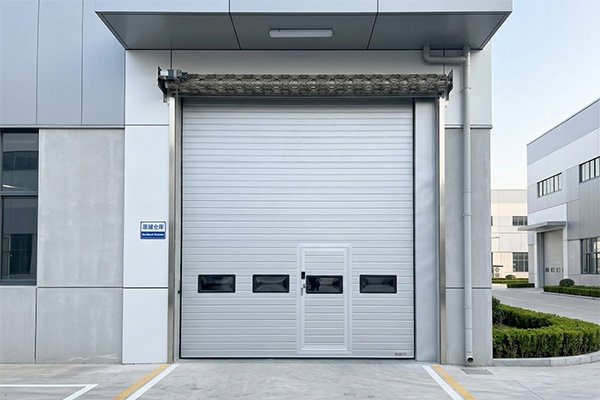

In the fast-paced environment of modern warehousing and logistics, the efficiency of entry points is paramount. However, efficiency must never come at the cost of personnel safety or equipment integrity. While many focus on electronic sensors, the true backbone of a reliable door system lies in its mechanical safeguards. Understanding industrial sectional door safety features is essential for facility managers and business owners who prioritize a secure working environment and long-term operational stability.
Even in configurations where infrared safety photocells are absent, a well-engineered sectional door utilizes a multi-layered mechanical defense system. This article explores four critical safety components: the safety bottom edge, torsion spring anti-break devices, wire rope anti-drop mechanisms, and end buffer devices. Together, these systems provide a “fail-safe” net that protects assets and lives.
1. Safety Bottom Edge: The First Line of Contact Defense
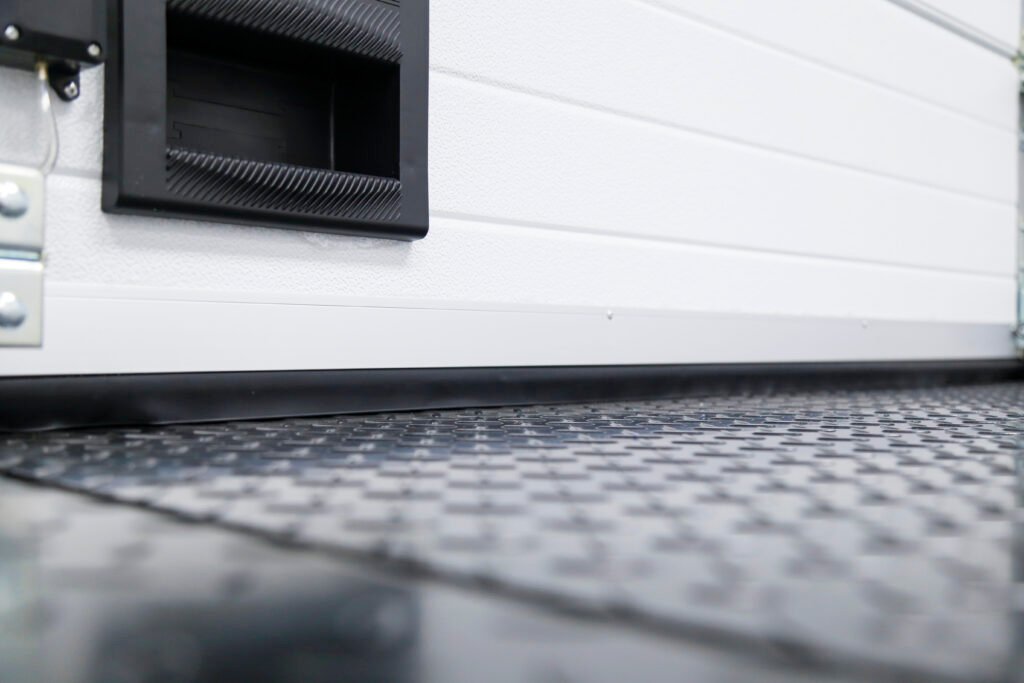
The safety bottom edge is an active protection device installed at the lowest point of the door panel. While infrared sensors detect obstacles from a distance, the safety bottom edge ensures that if the door physically encounters an object or person during its downward cycle, it responds instantly.
How It Works
The bottom seal of the door is equipped with a sensitive pressure-wave sensor or an optoelectronic sensor strip.
Pressure-Wave System: When the rubber seal is compressed, air is pushed through a tube to a pressure switch, which immediately sends a signal to the control box.
Response Action: Upon detection, the motor stops the downward movement and automatically reverses the door to the fully open position.
This feature is particularly vital in busy loading docks where small items or uneven surfaces might be missed by standard light beams. It ensures that the “closing force” never reaches a level that could cause injury or significant property damage.
2. Torsion Spring Anti-break Device: Preventing Gravitational Collapse
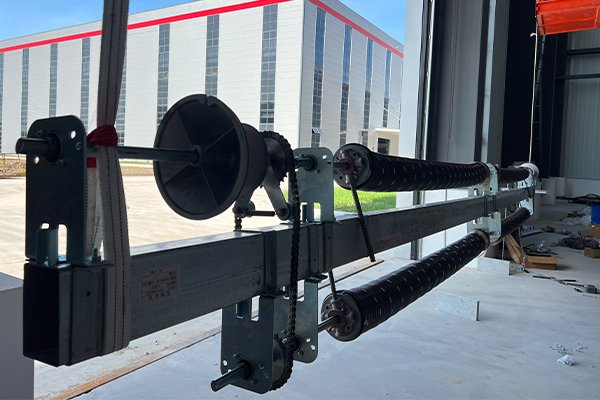
The torsion spring is the “muscle” of an industrial sectional door, counterbalancing the heavy panels to allow for smooth opening and closing. However, these springs are subject to high levels of fatigue over thousands of cycles. A spring failure on a door without safety backups can lead to a free-falling door—a catastrophic event.
The Mechanical Lock Mechanism
The torsion spring anti-break device is a specialized bracket installed on the shaft.
Detection: The device is kept in a “set” position by the tension of the spring itself.
Activation: If the torsion spring snaps, the sudden loss of tension causes a hardened steel pawl (a mechanical “tooth”) to snap out.
Braking: This pawl locks into a ratcheted wheel on the shaft, stopping the rotation of the shaft within degrees of movement.
By locking the shaft, the door panels are held firmly in place, preventing them from crashing down and allowing maintenance teams to safely replace the broken component.
3. Wire Rope Anti-drop Device: The Emergency Brake
While the springs handle the balance, the steel wire ropes (cables) do the heavy lifting. These cables connect the bottom of the door to the cable drums on the shaft. If a cable snaps due to wear, corrosion, or improper winding, the door will become unbalanced and drop on one side.
Instant Kinetic Braking
The wire rope anti-drop device is typically installed at the bottom corner of the door.
The Wedge System: The device is connected to the wire rope. As long as there is tension on the cable, the device remains retracted.
Emergency Engagement: If the cable loses tension (i.e., it breaks), a spring-loaded “knife” or wedge is released.
Rail Interlocking: This wedge bites deep into the vertical guide rail, using the weight of the door to wedge itself tighter.
This mechanism acts similarly to an elevator’s emergency brake, ensuring that even a total cable failure results in the door stopping safely within a few inches of travel.
4. End Buffer Device: Protecting the Track Integrity
Industrial doors operate at high speeds, and the momentum of a heavy door panel can be significant. The end buffer device is a simple yet crucial mechanical component installed at the very end of the horizontal tracks.
Absorbing Kinetic Energy
When a door is opened, especially by a powerful industrial motor, there is a risk of the door “over-traveling”—running past its intended stop point and potentially jumping out of the tracks or hitting the building’s structural beams.
The Buffer Action: The end buffer consists of high-tension springs or heavy-duty rubber stoppers.
Deceleration: As the door reaches its maximum open height, it makes contact with the buffer. The device absorbs the residual kinetic energy, providing a soft stop that prevents mechanical shock to the rollers, hinges, and the motor’s gearbox.
Why Mechanical Safety Matters in Industrial Doors
While electronic sensors like infrared photocells add a layer of convenience, they are prone to interference from dust, extreme sunlight, or electrical surges. Industrial sectional door safety features based on mechanical principles are “passive” yet “reliable”—they do not require a power source to engage in an emergency.
The Combined Safety Advantage
| Feature | Primary Risk Mitigated | Type of Protection |
| Safety Bottom Edge | Crushing obstacles/personnel | Active / Contact-based |
| Torsion Spring Anti-break | Spring fatigue/shaft rotation | Mechanical Lock |
| Wire Rope Anti-drop | Cable snapping/Gravity fall | Kinetic Wedge |
| End Buffer Device | Over-travel/Track damage | Impact Absorption |
Conclusion
Investing in a high-quality industrial sectional door means looking beyond the motor and the panel aesthetics. The true value is found in the hidden components that ensure the door remains a tool for productivity rather than a safety liability. By integrating a safety bottom edge, torsion spring anti-break devices, wire rope anti-drop mechanisms, and end buffers, you create a quadruple-layered safety system that protects your workforce and your facility 24/7.
When specifying doors for your next project, ensure these mechanical safety systems are included as standard. A safe door is a reliable door, and a reliable door is the key to an uninterrupted supply chain.
