
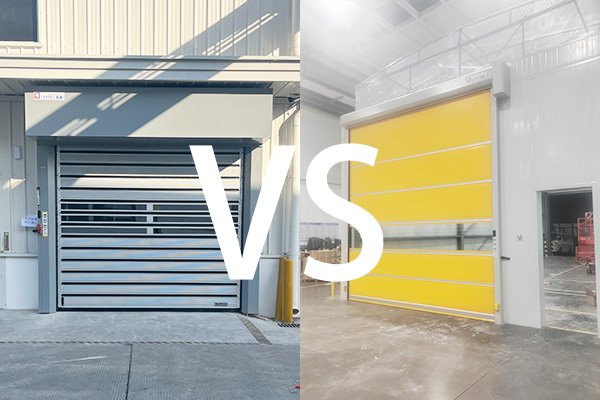

Introduction: In the era of Industry 4.0, every component of a manufacturing facility is a lever for efficiency. The Aluminum Spiral High-Speed Door has emerged as more than just a barrier…
When selecting doors for high-frequency external gates, many facility managers face a classic Capex (Capital Expenditure) dilemma: the significant price premium of Aluminum Spiral High-Speed Doors (“Hard Doors”) compared to standard PVC High-Speed Doors (“Soft Doors”). The temptation to save on initial costs often leads to a “budget trap”—where low-cost PVC doors struggle with wind pressure, security vulnerabilities, and frequent maintenance downtime.
How should a forward-thinking enterprise evaluate the ROI between a 2.0m/s aluminum solution and a 1.2m/s PVC alternative? Is the 0.8m/s difference merely a technical specification, or is it a strategic dividing line for operational success?
The choice must be based on the “Aperture Strategic Value.” For external gates with frequent vehicle traffic, the Aluminum Spiral Door is not an expense, but a high-yield asset. By leveraging superior velocity, rigid security, and advanced servo-motor precision—hallmarks of the SEPPES engineering philosophy—factories can achieve a TCO “break-even” within 24-36 months while eliminating the hidden costs of logistical friction.
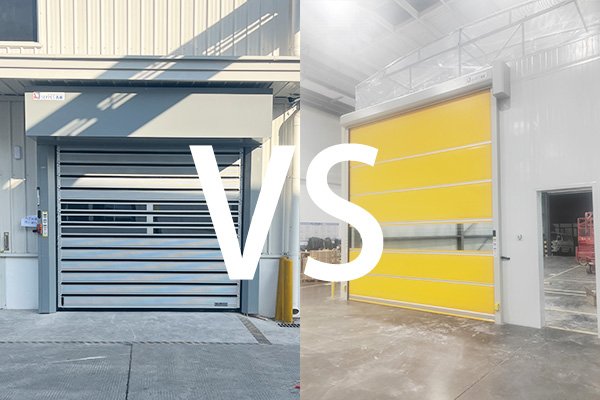
I. The Velocity Dividend: Achieving “Frictionless Passage”
In high-frequency logistics, time is literally energy. The difference between 1.2m/s and 2.0m/s is not linear; it is transformative for the “Time Window of Exposure.”
1. Minimizing the “Exposure Window”
Consider a standard 4-meter-high external gate. A SEPPES Aluminum Spiral Door, operating at 2.0m/s, clears the opening in just 2 seconds. A standard PVC door at 1.2m/s requires over 3.3 seconds.
The Impact: When factoring in the closing cycle and the hundreds of daily transits by forklifts and trucks, the 2.0m/s speed reduces the time the door is open by nearly 40%. This drastically cuts heat exchange, maintaining stable indoor temperatures and reducing HVAC energy consumption by an estimated 15-25% annually.
2. The Servo-Motor Advantage: Precision over Power
High speed requires sophisticated control. While PVC doors often rely on basic asynchronous motors with high mechanical wear, SEPPES utilizes high-performance Servo Drive Systems.
Why it matters: Servo motors allow for “Soft Start and Soft Stop” profiles. This eliminates the violent mechanical jarring associated with rapid movement, ensuring that the door can handle 1,000+ cycles per day with millimeter-level precision and minimal motor fatigue. For the “Industrial Technology Company” case study, this transition ensured that vehicle flow was never throttled by door cycle times.
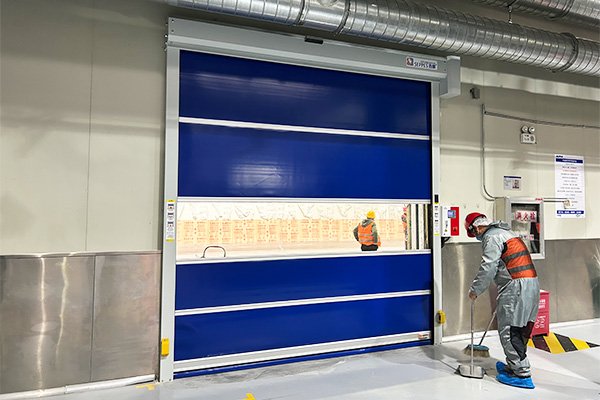
II. Structural Integrity: The External Gate as a Fortress
An external gate is a facility’s first line of defense against both the elements and unauthorized access—a role where PVC inherently falls short.
1. Wind Resistance and Environmental Control
External gates are subject to “Stack Effect” and high wind loads. A PVC “Soft Door” acts like a sail; under high wind pressure, the curtain can bulge, leading to seal failure or track jamming.
The SEPPES Standard: Our Aluminum Spiral Doors feature double-layered, insulated aluminum slats. This “rigid” architecture provides an anti-wind rating of up to Class 11 or 12 (Hurricane strength). For an external gate, this ensures the facility remains operational and airtight even during extreme weather, preventing costly production halts.
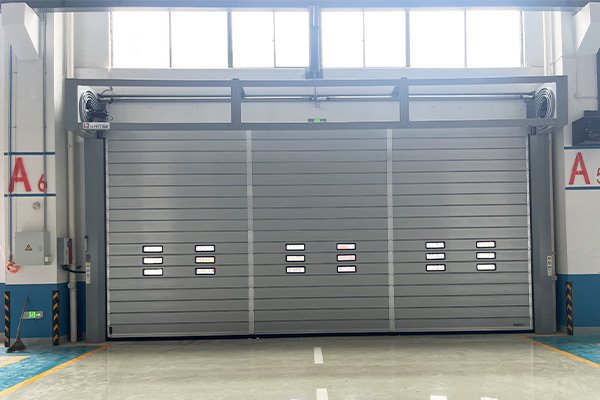
III. Active Safety: Transitioning from “Passive Protection” to “Active Defense”
In the high-speed world of 2.0m/s, safety cannot be an afterthought; it must be an integrated, redundant system. This is where the SEPPES engineering philosophy diverges from entry-level PVC solutions.
1. The “Zero-Contact” Mandate
Standard PVC doors often rely on a single-point photocell or a “wireless safety edge” that requires physical impact to trigger a reversal. In a high-throughput environment, even a minor “bump” can damage fragile cargo or misalign a forklift.
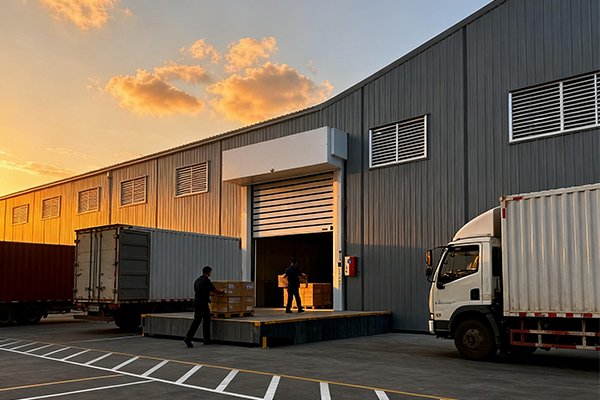
The SEPPES Solution: We utilize multi-point Infrared Light Curtains integrated directly into the side tracks, reaching heights of up to 2.5 meters. This creates an invisible “safety wall.” If any part of a vehicle or a pedestrian breaks this curtain, the door reverses instantly without any physical contact.
2. Intelligent Triggering: Microwave Radar and Induction Loops
For the “Industrial Technology Company” mentioned earlier, efficiency is gained in the seconds before the vehicle reaches the door.
Predictive Opening: By using industrial-grade Microwave Radar or Geomagnetic Induction Loops, SEPPES doors distinguish between a person walking by and a forklift approaching. The door is already at full height by the time the vehicle arrives, enabling “Seamless Passage.” This eliminates the “stop-start” cycle, reducing brake wear on forklifts and tire degradation.
IV. The TCO Calculation: Why “Premium” is the Ultimate Cost-Saver
A McKinsey-style analysis looks past the initial invoice. We evaluate the Total Cost of Ownership (TCO) over a 5-year operational horizon.
| Cost Driver | PVC High-Speed Door (Soft) | SEPPES Aluminum Spiral (Hard) |
| Initial Capex | Low (Baseline) | High (2x – 3x Baseline) |
| Energy Loss | High (Slower cycle, air leakage) | Low (Insulated slats, 2.0m/s cycle) |
| Maintenance | Frequent (Curtain tears, motor strain) | Minimal (Precision servo, rigid slats) |
| Security | Requires secondary shutter | Integrated night-time security |
| Operational Life | 5 – 10 Years (at high frequency) | 10 – 15+ Years |
The “Break-Even” Point
While the Aluminum Spiral High-Speed Door requires a higher upfront investment, the ROI “Cross-over” typically occurs within 24 to 36 months. This is driven by three factors:
Elimination of Double-Door Systems: Since a SEPPES door is both a high-speed door and a secure night door, you save the cost of installing a secondary rolling shutter.
Downtime Mitigation: In a “Just-in-Time” manufacturing environment, a single day of a “door stuck open” due to a torn PVC curtain can cost more in lost productivity and energy than the price gap between the two doors.
Longevity: SEPPES doors are rated for millions of cycles. While a PVC high speed door may need a full curtain or motor replacement after 2 years of external high-frequency use, the Aluminum Spiral High-Speed Door remains in its peak performance window.
V. Conclusion: Making the Strategic Choice
[Summary of Insight]
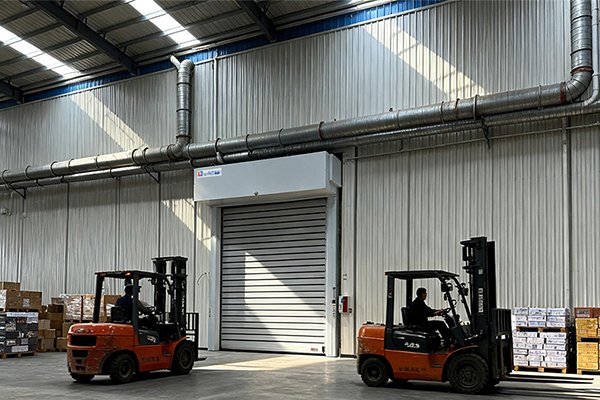
The decision between a PVC high speed door and an Aluminum Spiral High-Speed Door is not a procurement choice; it is a facility performance strategy. For internal cleanrooms or low-traffic partitions, PVC remains a viable, cost-effective tool. However, for the External Logistic Gateway, the stakes are higher.
[The SEPPES Recommendation]
If your facility handles more than 50 vehicle transits per day and requires a balance of speed, thermal insulation, and security, the SEPPES Aluminum Spiral Door is the only logical choice. It transforms a potential bottleneck into a high-speed conduit for operational excellence.
