
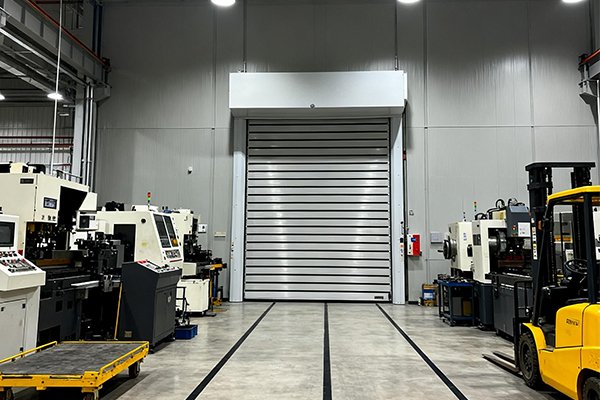

When you’re researching aluminum alloy high speed doors, one feature consistently stands out: their impressive speed. You might have seen the numbers: aluminum alloy high-speed doors can open at 1.2-2.0 meters per second (about 4-6.5 feet per second), while traditional PVC roll-up doors typically operate at 0.8-1.2 meters per second (about 2.5-4 feet per second). This seemingly small difference can lead to a significant boost in efficiency in busy industrial settings where doors open and close frequently.So, what exactly makes aluminum alloy high speed doors so much faster?
The Core Difference: Rigid vs. Flexible Structures
PVC Roll-Up Doors (Flexible Structure): The door curtain is made of soft PVC material. It operates much like a window shade, needing to roll up and wind around a drum at the top.
Aluminum Alloy High Speed Doors (Rigid Structure): The door curtain is constructed from horizontally connected, high-strength, lightweight aluminum alloy slats. Its operation is more akin to a vertical lift, moving rapidly within reinforced side guides.

Three Key Technologies Powering Aluminum Alloy High Speed Door Speed
Rigid Door Panels and Robust Guide Rails
Wind Resistance & Stability: When operating at high speeds, flexible PVC curtains can easily “billow” or shake due to wind pressure and differential air pressure between the inside and outside. This limits their maximum speed, as there’s a risk of the door coming out of its tracks or being damaged. Aluminum alloy door panels, on the other hand, offer extremely high wind resistance. They run within sturdy aluminum guide rails on both sides, leaving virtually no room for lateral movement, ensuring stability even at speeds of 2.0 m/s (6.5 ft/s).
Reduced Resistance: Rigid door panels slide along straight guide rails, encountering predictable and consistent air and friction resistance. In contrast, a soft PVC curtain constantly changes shape as it rolls up and down, creating more complex friction with the air and itself, which subtly restricts its acceleration capabilities.
Powerful Drive System and Precise Control
High-Performance Servo/Variable Frequency Motors: Aluminum alloy high speed doors commonly use high-torque servo motors or vector variable frequency drive control systems. These systems provide incredibly smooth soft-start and soft-stop functions. They can deliver immense torque in an instant to accelerate the door to maximum speed, then precisely decelerate at the end of its travel, preventing harsh impacts from high inertia. Many lower-end PVC roll-up doors, using standard motors, experience more jarring starts and stops, limiting their performance tuning.
High-Precision Encoders: Servo motors incorporate high-precision encoders that provide real-time feedback on the exact position of the door curtain. The control system uses this information to adjust motor speed and torque in milliseconds, ensuring precise positioning. This is the technical guarantee for high-speed, high-frequency operation without deviation.
Optimized Operating Logic and Safety Design
Optimized Motion Curve: The control programs for aluminum alloy high-speed doors are deeply optimized, featuring a more scientific speed-time curve. Typically, this involves rapid acceleration, high-speed constant velocity, and smooth, early deceleration. The entire process is fluid and efficient, significantly reducing total transit time. For safety and stability, PVC roll-up door motion curves are often more conservative.
Balance System: Aluminum alloy high speed doors are often equipped with a torsion spring balance system. This system effectively counteracts the door panel’s self-weight. This means the motor’s primary power is used for acceleration and overcoming friction, making it easier to achieve higher speeds.
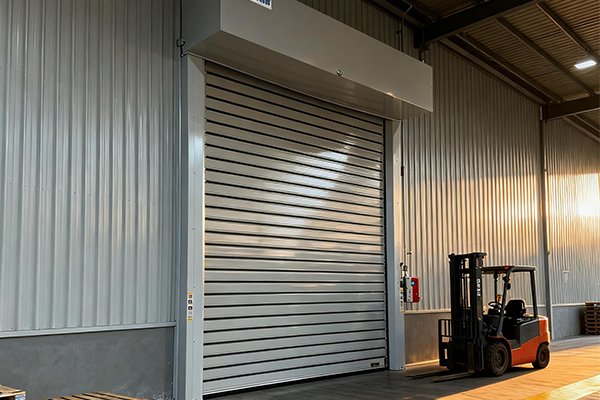
Aluminum Alloy High Speed Doors vs. PVC Roll-Up Doors
| Feature | Aluminum Alloy High Speed Door | PVC Roll-Up Door |
| Typical Speed | 1.2 – 2.0 m/s (4-6.5 ft/s) | 0.8 – 1.2 m/s (2.5-4 ft/s) |
| Curtain Material | Aluminum Alloy | PVC |
| Structural Property | Structure Rigid, Sectional | Flexible, Single Panel |
| Wind Resistance | Extremely Strong | Moderate |
| Insulation/Seal | Excellent | Excellent |
| IApplicable Scenarios | High-frequency, demanding passages (e.g., cleanrooms, exterior entryways, logistics sorting centers) | Medium-frequency indoor partitions (e.g., warehouses, internal factory areas) |
| Safety | High | High |
How to Choose Your Door
When your application demands high throughput and environmental control, choosing an aluminum alloy high speed door isn’t just about gaining a fraction of a second in speed. It’s about investing in a reliable, durable, and comprehensive solution that can significantly enhance the efficiency of your entire operational workflow.
If you’re looking for a high speed door for your factory, warehouse, or cleanroom that can boost efficiency and potentially lower energy consumption, contact the SEPPES professional team for a better door solution.
