
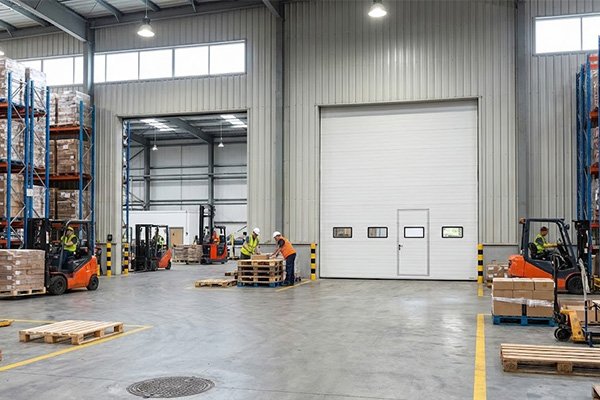

For warehouse managers and cold chain logistics providers, the industrial door is often the largest “hole” in a building’s thermal envelope. If you are struggling with rising energy bills or fluctuating indoor temperatures, the culprit isn’t just the door panel—it’s the thermal leakage at the joints and edges.
In this article, we analyze how SEPPES Insulated Industrial Sectional Doors solve these real-world energy challenges through precision engineering.
The Hidden Cost of Poor Insulation: The “Chimney Effect”
Many standard industrial doors claim to be “insulated” simply because they contain foam. However, without a professional sealing system, heat escapes through gaps via the “chimney effect.” This leads to:
Skyrocketing HVAC Costs: Your heating or cooling system works overtime to compensate for the loss.
Product Spoilage: In sensitive industries like food or pharmaceuticals, a 2℃variance can ruin inventory.
Equipment Wear: Constant cycling of climate control units leads to premature maintenance costs.
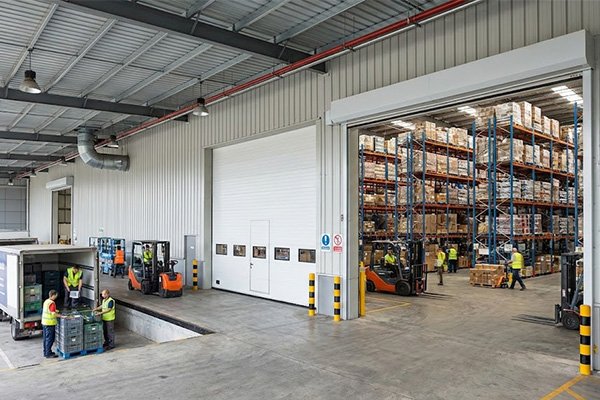
The SEPPES Solution: Beyond Just “Thick Panels”
While SEPPES offers high-density, CFC-free polyurethane (PU) foam panels (available in 40mm, 50mm, or even 75mm thickness), our true secret to thermal efficiency lies in our integrated sealing architecture.
1. Multi-Point EPDM Weather Sealing
Standard doors use low-grade plastic strips that crack in the cold. SEPPES utilizes EPDM (Ethylene Propylene Diene Monomer) rubber gaskets on all four sides:
Top & Side Seals: Flexible double-fin gaskets that remain pliable from−20 ℃to +40 ℃.
Bottom U-Shaped Seal: Compensates for uneven floors, creating an airtight barrier against wind and rain.
2. The “Thermal Break” Technology
Metal is a high conductor of heat. Without a “thermal break,” the outer skin of the door transfers cold directly to the inner skin (thermal bridging). SEPPES sectional doors feature a structural break between the interior and exterior steel skins, effectively stopping the flow of thermal energy.
3. Tongue-and-Groove Joint Precision
Every panel joint is engineered with a deep tongue-and-groove profile. When the door closes, these panels interlock tightly, creating a continuous wall of insulation that prevents air infiltration.
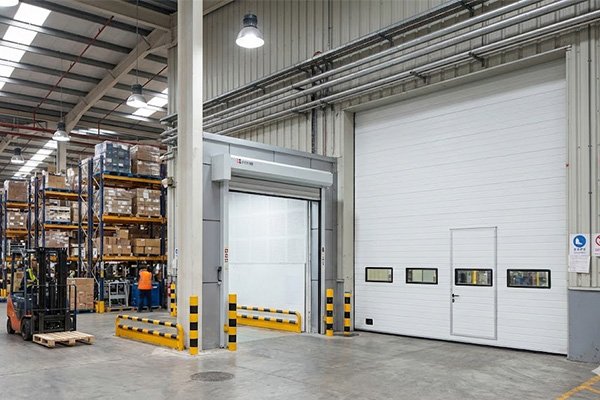
Technical Performance Comparison
| Feature | Standard Industrial Door | SEPPES Insulated Sectional Door |
| Core Material | Low-density Foam | 48kg/m³ High-density PU Foam |
| Seal Material | PVC or Plastic | Heavy-duty EPDM Rubber |
| Thermal Conductivity | High (due to metal contact) | Low (Thermal Break Design) |
| Wind Resistance | Class 1-2 | Class 3-4 (Reinforced Structure) |
| Energy Savings | Minimal | Up to 40% reduction in thermal loss |
Real-World Impact: A Case Study
A logistics center in Northern Europe replaced 20 traditional rolling shutters with SEPPES Insulated Industrial Sectional Doors. Within the first winter season, they reported a 28% reduction in heating energy consumption and a significantly more comfortable working environment for their forklift operators, leading to higher productivity.
Expert Tip: When selecting an insulated door, always ask for the U-Value (Thermal Transmittance). A lower U-value means better insulation. SEPPES doors are designed to meet stringent international standards for thermal efficiency.
Conclusion: Invest in Performance, Not Just a Barrier
An industrial door should be more than just a security gate; it should be an active component of your building’s energy management strategy. By focusing on superior sealing and thermal break technology, SEPPES Insulated Industrial Sectional Doors provide a measurable Return on Investment (ROI) through energy savings and cargo protection.
Ready to Optimize Your Facility?
Contact SEPPES today for a customized thermal efficiency audit and a quote on our premium insulated door solutions. Let us help you keep the climate in and the costs down.
