
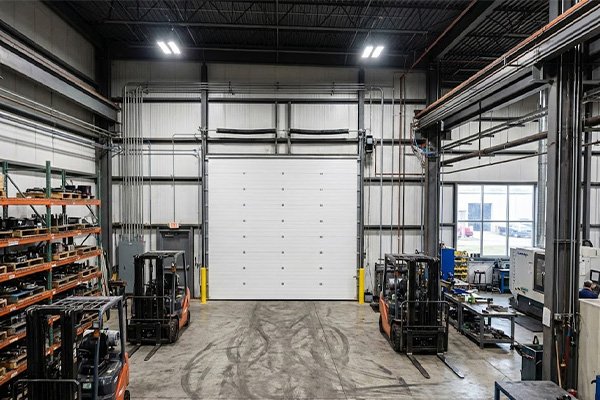

Choosing the right overhead door insulation thickness is often the difference between a facility that is cost-effective to run and one that drains your energy budget. For industrial facilities, the debate usually boils down to two industry standards: 40mm vs. 50mm sandwich panels.
While 10mm might seem like a negligible difference, in the world of thermal thermodynamics and structural integrity, it represents a significant shift in performance. This guide will help you determine which thickness is the “sweet spot” for your specific operational needs.
The Core Conflict: Thermal Resistance vs. Initial Investment
Most facility managers face the same problem: Will the energy savings of a thicker door eventually pay for the higher upfront cost?
To answer this, we need to look at the R-value (resistance to heat flow) and the U-value (thermal transmittance). The thicker the polyurethane (PU) foam core, the lower the U-value, meaning less heat escapes your building.

40mm Panels: The Versatile Standard
The 40mm panel is the “workhorse” of the industrial door industry. It is the global standard for most warehouses and logistics centers.
Best For: Temperate climates, standard dry warehouses, and interior partitions.
Pros: Lighter weight (less strain on the motor/springs), faster operation potential, and lower initial cost.
Insulation Performance: Provides sufficient thermal protection for environments where the temperature difference between inside and outside is moderate
50mm Panels: The High-Performance Shield
When you step up to 50mm, you aren’t just adding foam; you are enhancing the door’s structural rigidity and thermal barrier.
Best For: Cold storage facilities, extreme weather regions (very hot or very cold), and large-scale openings where wind load is a factor.
Pros: Higher R-value, better sound dampening, and increased resistance to panel deflection (bending).
Insulation Performance: Specifically designed to maintain strict climate control, significantly reducing the “thermal bridging” effect.
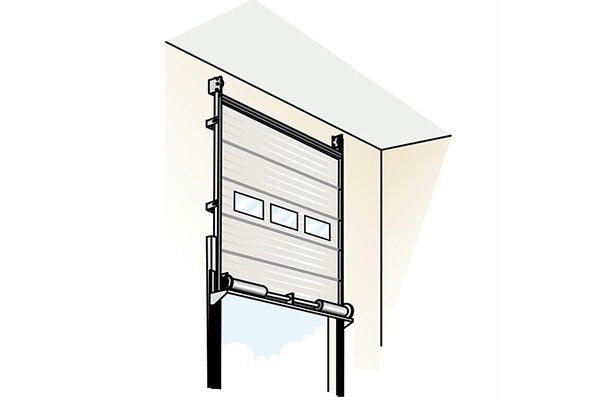
Comparison Table: 40mm vs. 50mm Overhead Doors
| Feature | 40mm PU Sandwich Panel | 50mm PU Sandwich Panel |
| Thermal Insulation | Standard (U≈0.50W/m2K) | Enhanced (U≈0.40W/m2K) |
| Structural Strength | Moderate | High (Better for wide doors) |
| Weight | Approx. 11-13 kg/m² | Approx. 14-16 kg/m² |
| Sound Insulation | ≈ 24 dB | ≈ 26-28 dB |
| Primary Usage | General Logistics / Manufacturing | Cold Chain / Heavy Industry |
Why SEPPES Insulation Technology Stands Out
At SEPPES, we recognize that thickness is only one part of the equation. A 50mm door is useless if air leaks through the joints. Our overhead doors focus on three critical “Problem-Solvers”:
High-Density PU Foam: We use CFC-free high-density polyurethane foam. This density ensures that the “insulation thickness” actually performs to its theoretical maximum without air pockets.
Double-Lip Peripheral Sealing: Thickness handles conduction; our EPDM rubber seals handle convection. By sealing the gap between the panel and the track, we prevent “air leakage,” which is responsible for up to 40% of energy loss in industrial buildings.
The Thermal Break Design: SEPPES panels are engineered to ensure the outer steel skin does not touch the inner steel skin. This “thermal break” prevents the metal from conducting heat directly through the door.

The Verdict: Which Should You Choose?
Choose 40mm if: You are operating a standard warehouse in a mild climate and your primary goal is security and basic weather protection. It is the most cost-effective solution for 80% of industrial applications.
Choose 50mm if: You are storing temperature-sensitive goods (pharmaceuticals, food), your facility is in an area with extreme seasonal shifts, or you have an oversized door (over 6 meters wide) that requires extra structural stiffness.
Real-world tip: If your energy costs have risen by more than 15% in the last year, upgrading to a 50mm SEPPES Sectional Door can often see a Return on Investment (ROI) within 24–36 months through reduced HVAC load alone.
Ready to Optimize Your Facility?
If you’re unsure which overhead door insulation thickness fits your local building codes or energy goals, we can help.
