
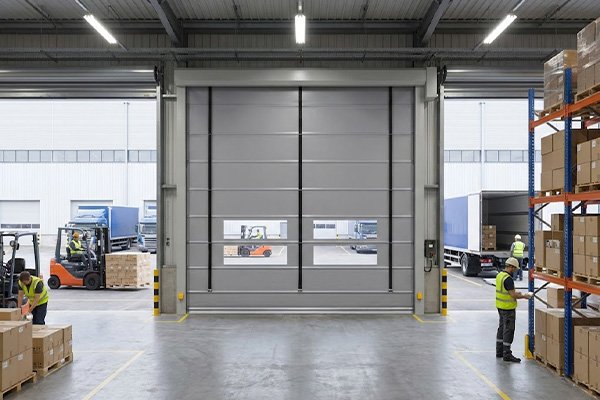

If you’ve ever stood in a large warehouse during a storm and heard the ominous thud-rattle-crack of a standard roll-up door struggling against the wind, you know the feeling. It’s not just noise; it’s the sound of a looming repair bill and a massive security risk.
When it comes to high wind areas—coastal regions, mountain passes, or even just massive hangars with high internal pressure—standard high-speed doors often fail. They “curtain blow out” or, worse, the tracks bend under the strain.
At SEPPES, we’ve seen this play out too many times. That’s why we recommend the High-Speed Stacking Door (also known as a Fold-Up Door) as the heavy-duty champion for these environments. Here is how focusing on one specific design feature solves your wind-load woes.
The Secret Weapon: Horizontal Reinforcement Ribs
Most high-speed doors are “roll-up” style—they behave like a window shade. In high winds, that thin fabric acts like a sail, putting immense pressure on the side guides.
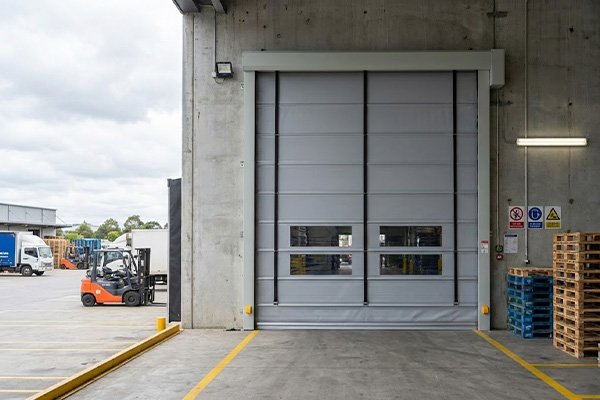
SEPPES Stacking Doors work differently. Instead of rolling, they fold. This design allows us to integrate high-strength aluminum or steel wind-resistant ribs horizontally across the entire width of the curtain.
Why This Solves Your Problem:
Skeleton vs. Skin: Think of a standard door as just “skin.” A SEPPES stacking door has a “skeleton.” These ribs distribute the wind pressure directly into the vertical tracks and the building’s structure, rather than letting the fabric take the hit.
No More “Blow-Outs”: Because the ribs are physically locked into the side frames, the curtain can’t be sucked out of its tracks by a gust of wind.
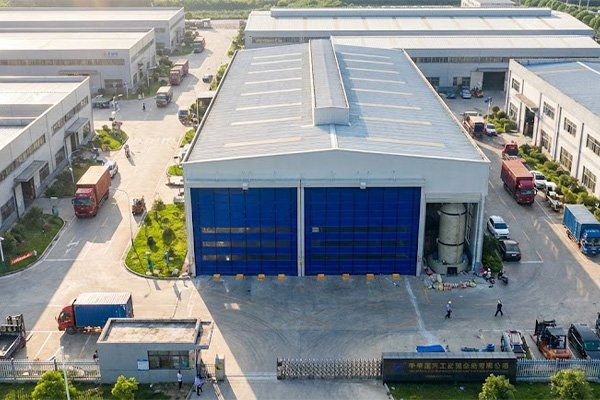
Massive Scale: This structural integrity allows these doors to cover huge openings (up to 12 meters wide or more) where a standard door would simply collapse.
More Than Just Brute Strength
While the wind-resistant ribs are the “brawn” of the operation, the stacking mechanism provides the “brains.”
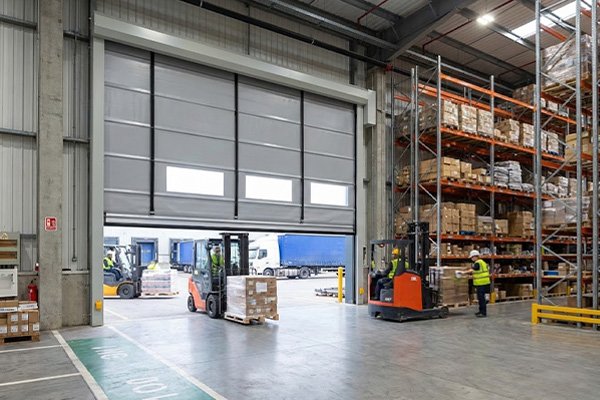
High-Speed Efficiency: Despite being heavy-duty, these doors don’t move like snails. They maintain speeds of up to 0.6m/s – 1.2m/s, ensuring your logistics flow isn’t sacrificed for safety.
Safety First: In high wind areas, a failing door is a projectile. SEPPES doors include infrared safety sensors and bottom-edge wireless monitors to ensure that if anything (or anyone) is in the way, the door stops instantly.
The “Tight Seal” Factor: High wind usually brings dust, rain, and temperature fluctuations. Our stacking doors utilize a heavy-duty EPDM weather seal at the bottom to ensure that once the door is down, the outside stays outside.
Why SEPPES?
We don’t just build doors; we build “peace of mind.” Every SEPPES High-Speed Stacking Door is engineered to meet international standards (CE and SGS certified). We’ve installed these in some of the most demanding environments globally—from dusty mining sites to high-pressure logistics hubs.
Pro Tip: If your facility is larger than 25 square meters and faces open terrain, “standard” is no longer an option. You need a door designed for the load.
Ready to Stop Replacing Blown-Out Doors?
Wind shouldn’t dictate your productivity. If you’re tired of repairing doors every time the weather turns, it might be time to move from a “shade” to a “shield.”
