
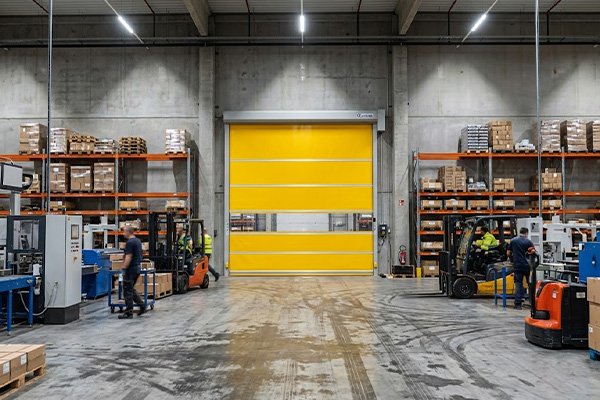

In the world of industrial logistics, time isn’t just money—it’s the difference between a smooth operation and a chaotic bottleneck. If you’ve ever watched a forklift driver come to a grinding halt because a “high-speed” door didn’t live up to its name, you know the frustration.
Today, we’re looking at why a radar induction fast door is the secret weapon for modern warehouses, specifically how SEPPES solves the “Ghost Opening” problem that plagues cheaper alternatives.
The Headache: When “Smart” Doors Act Dumb
We’ve all seen it: a high-speed door that opens every time a person walks past it, even if they have no intention of going through. Or worse, a door that fails to “see” a forklift until the driver is inches away, forcing a hard brake.
Common issues with subpar induction systems include:
Energy Loss: The door stays open for cross-traffic, letting expensive climate-controlled air escape.
Safety Risks: Sudden stops lead to skidding and potential collisions.
Mechanical Wear: Constant, unnecessary cycling shortens the lifespan of the motor and the curtain.
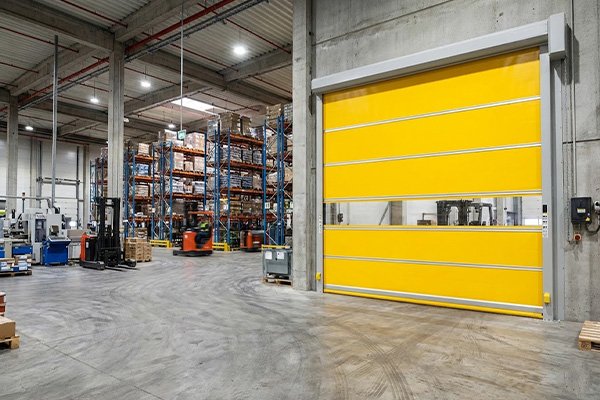
The Solution: SEPPES Precision Radar Induction
A SEPPES radar induction fast door doesn’t just “detect motion”—it analyzes it. Using microwave sensor technology, these doors are designed to distinguish between a vehicle approaching the opening and someone simply walking parallel to it.
1. Directional Detection (The “No-Ghost” Feature)
Cheap sensors are omnidirectional; if anything moves nearby, the door triggers. SEPPES utilizes directional microwave radar. It can be programmed to ignore “receding” traffic or “lateral” traffic.
Scenario: A forklift is driving past the door to reach a different aisle. A standard door would fly open. A SEPPES door stays shut because it recognizes the movement isn’t toward the threshold.
2. Adjustable Sensing Distance
Not every loading dock is built the same. Whether you have a tight corridor or a wide-open staging area, the radar can be fine-tuned (typically from 1 to 10 meters) to match your specific traffic flow. This ensures the door is fully open exactly when the vehicle arrives, allowing for “non-stop” passage.
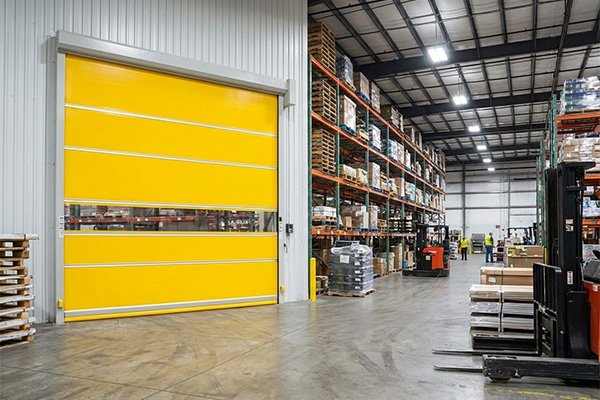
Why SEPPES? It’s About the “Brain”
Beyond the hardware, SEPPES integrates these sensors with a high-performance control system (often utilizing Siemens or specialized PLC platforms). This “brain” processes the radar signal instantly, ensuring a transition speed of up to 2.0m/s.
| Feature | Impact on Your Facility |
| Filtered Sensing | Eliminates 90% of “false opens” caused by cross-traffic. |
| High-Frequency Microwave | Operates reliably in dusty, humid, or dark environments. |
| Hands-Free Logic | Drivers never have to pull a cord or press a button, keeping hands on the wheel. |
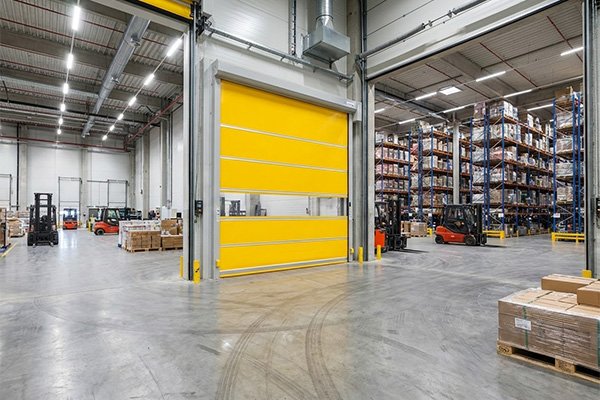
Real-World Impact: Efficiency Meets Longevity
By solving the false-triggering problem, you aren’t just saving a few seconds per trip. You are protecting your bottom line. Less unnecessary movement means the door’s torsion springs and motor last years longer, and your HVAC system isn’t working overtime to compensate for a door that won’t stay shut.
If you’re tired of doors that act like they have a mind of their own, it might be time to upgrade to a system that actually understands your workflow.
