


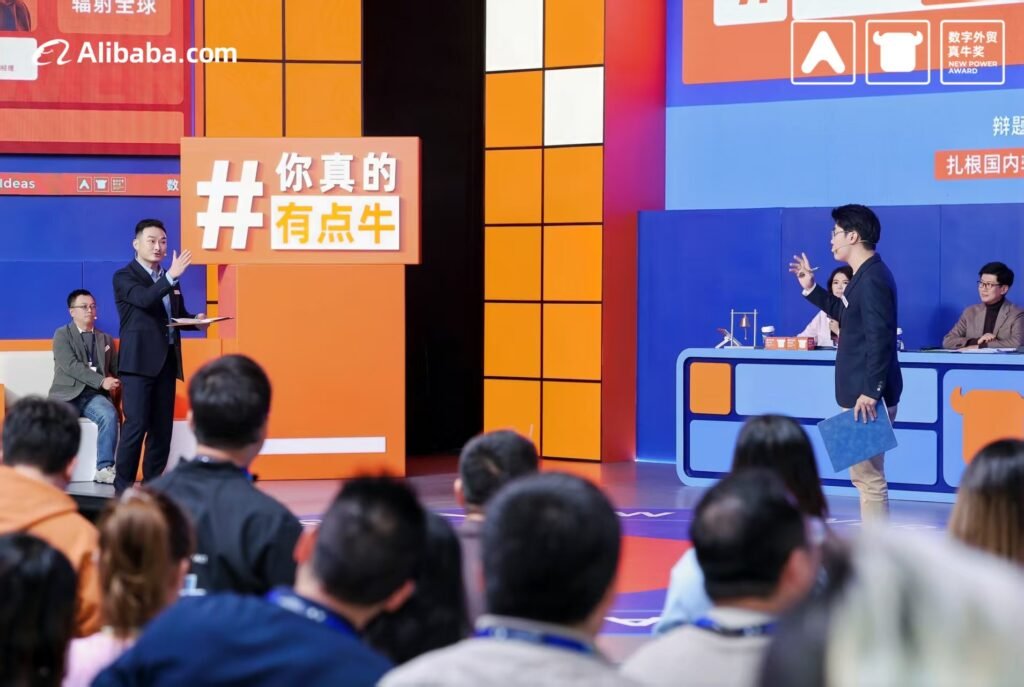
The 2025 Alibaba.com “Zhenniu Award” (often called the “Foreign Trade Debate Excellence Award”) recently concluded. Over the course of a seven-hour debate, 20 top global exporters discussed strategies for navigating an era of uncertainty. Yang Yuanjia, General Manager of SEPPES Door Industry(Suzhou) Co., Ltd., was honored as a “2025 Annual Zhenniu Award TOP 10” winner. His debate theme, “Rooted in China, Radiating Globally,” garnered support from tens of thousands of trade professionals and became a central highlight of the event.

From “World Factory” to “Global Solution Provider”
This annual gathering signaled a core consensus: the “evolution within change”. Modern Chinese exporters have moved beyond being mere “movers for the world’s factory” to becoming “decoders of global demand”. The story of Yang Yuanjia and SEPPES serves as a vivid microcosm of this intelligent upgrade and high-quality expansion.
As an entrepreneur born in the 1980s who initially spoke no English, Yang spent a decade transforming SEPPES from a company that “dared not compete with foreign brands” to one that “surpasses foreign brands”. Today, SEPPES industrial doors are installed in top-tier German automotive plants, and the company boasts a powerful track record: one in every seven Fortune 500 companies chooses SEPPES. Through the Alibaba.com platform, the company has successfully opened doors to markets in over 70 countries.

Redefining Industrial Doors with Intelligence
“Rooting in China and radiating globally isn’t just a slogan; it’s a conclusion we’ve ‘installed’ door by door using our experience serving over 70 countries,” Yang stated during the debate. SEPPES focuses on the R&D and production of intelligent industrial doors specifically designed for factories and production lines.
Unlike traditional, noisy rolling shutters, SEPPES intelligent doors offer more than just fast and smooth automated operation.
Automation Synergy: They can “communicate” precisely with AGVs (Automated Guided Vehicles) and robotic arms to enable automated material flow.
Smart Diagnostics: Equipped with intelligent large screens, the doors display real-time status. In the event of a failure, the screen immediately identifies the issue in the local language, significantly reducing maintenance costs.
“Rooted in China”: The Power of the Supply Chain
Yang believes these core competencies depend on the strategic choice to remain “Rooted in China”. China’s complete industrial ecosystem provides the complex engineering support needed for high-frequency, unmanned door operations and continuous technical iteration.
Consequently, SEPPES maintains its two major factories, headquarters, and core service teams within China. Meanwhile, customer acquisition and demand matching are handled via Alibaba’s digital platform. This allows the domestic team to provide efficient responses, often delivering solutions and quotes on the same day the customer submits an inquiry online.

Overcoming Distance with Systems, Not Manpower
To solve the “on-site service” challenge common in exports, Yang utilizes intelligence to bridge the geographical gap.
Self-Service Repair: For minor issues like loose screws, customer engineers can resolve them following prompts on the smart screen.
AI Support: For complex problems, customers can upload screen data via Alibaba’s AI customer service for 24-hour online guidance.
Auto-Recovery: With a control system that features automatic recovery upon reboot, most projects do not require an on-site engineer.
“It takes hours for a local European team to reach a site, and email communication can take days, which halts factory production,” Yang explained. “Our system recovers automatically—faster than any person can run.”. After using SEPPES products, one top-tier German car factory noted they were “smarter and better than those from local suppliers”.

The Future: Exporting Intelligent Systems
By staying rooted in China, SEPPES has accurately captured the trend of integrating intelligent manufacturing with the Internet of Things (IoT), utilizing China’s mature IoT supply chain to perfect its product range. Yang uses a military metaphor for this logic: “Don’t overextend your supply lines before the base is secure. The core advantage of ‘Made in China’ is its complete supply chain and massive manufacturing scale. Breaking these advantages apart to scatter them across different countries is like tearing down a fortress to build small huts”.
The SEPPES model now serves as a benchmark for the industry: instead of competing on old-fashioned tracks, the company builds core advantages at home and uses intelligence to overtake competitors on the global stage. As Yang concluded in his acceptance speech: “Going global isn’t about flying people out; it’s about sending intelligent systems out. Firmly plant your roots in China first, and let the world find you”.
According to representatives from Alibaba.com, Yang’s philosophy reflects the broader shift in Chinese exports from “scale expansion” to “quality improvement”. With the empowerment of AI and digital platforms, more “AI-native trade enterprises” like SEPPES are rising to redefine “advanced trade”.
